Tania Willard’s Photolithics is on view at The Polygon Gallery from March 7 to May 31, 2026 in North Vancouver, BC.
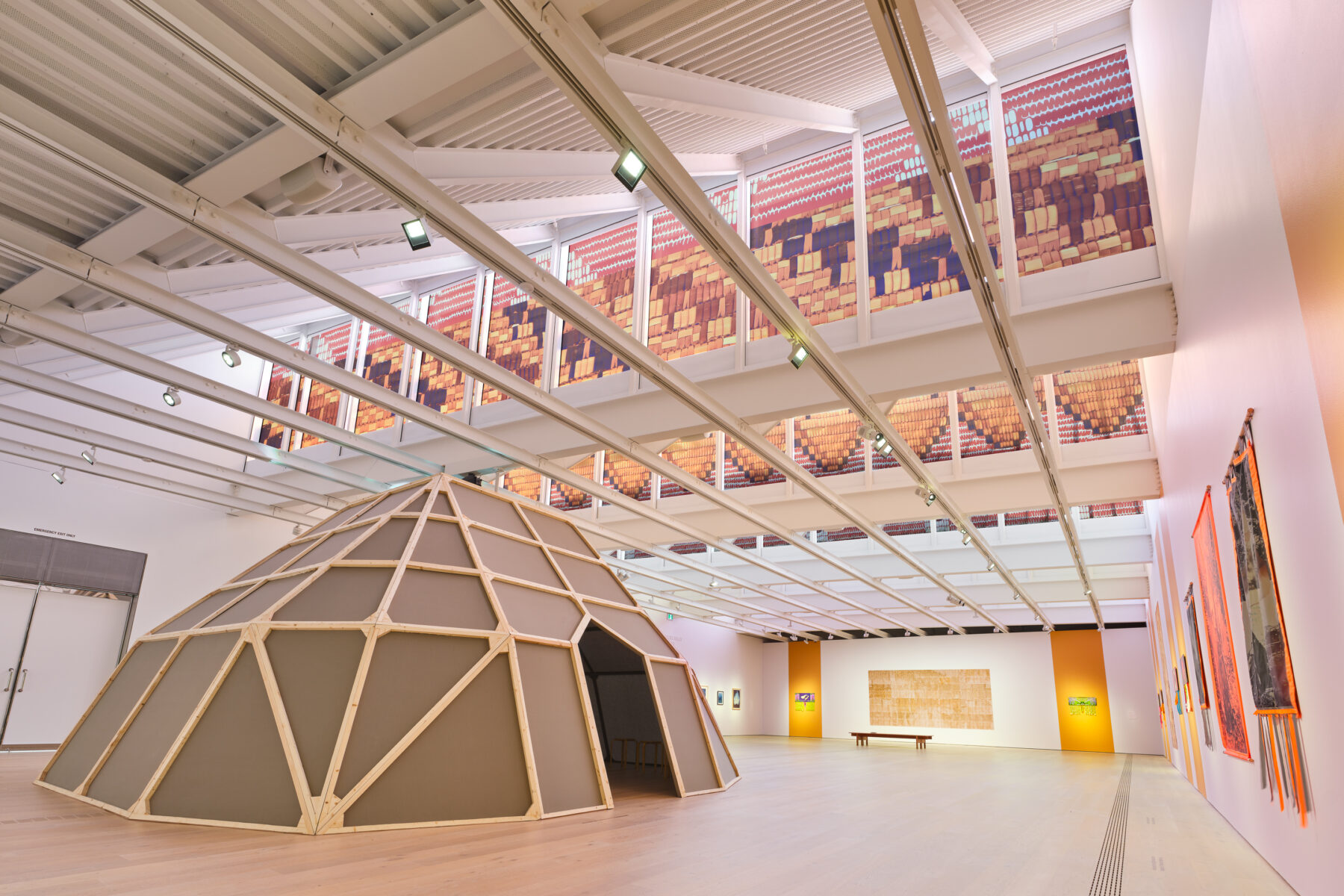
As I enter the upstairs gallery of The Polygon, the air shifts. I am greeted by amber light filtering through the cedar-patterned windows above, the resonance of a drumbeat and a crescendo of voices filling the room. The atmosphere feels almost ceremonial, as if I am stepping inside a cathedral or standing among a grove of ancient cedars. Already, the space is asking me to move differently from how I arrived.
I am drawn to the composition of the works in Tania Willard’s Photolithics before the subject matter emerges. The pieces hold complexity in their formation, emphasizing how their materials have carried the impact of interconnection with land and memory across time. Bark, root, stone, pigment… these are not materials chosen for their symbolism – they are here because they have always been here. They have been doing the work of holding memory long before anyone thought to call it an archive.
Tania Willard, a multimedia artist of Secwépemc and settler-Scottish descent, has spent ten years assembling a body of work that challenges how Western institutions understand record-keeping. Colonial archives do not preserve memory in a neutral way— they hold the object and sever its relation, calling what remains a record. Photolithics proposes a different understanding entirely. The land itself is the oldest archive. Cedar and quartz and stone carry lineage and memory not as metaphor, but as fact. To work with these materials is to enter into relation with something that is still active. To work with cedar is to work with a relative. To photograph stone is to enter into a relationship with something that has been witnessing this place for longer than any human institution.
Willard’s words, positioned on the wall of the stairwell leading into the exhibition, meet each visitor as they enter the space: “A stone represents the entire set of processes involved in the formation of the Earth; we can read deep time through understanding and examining the geological conditions in which it was made. A photograph can similarly be read in terms of its paper and chemistry, its format and borders, its construction and composition, its subject matter and socio-political context. If you look in this way, with knowledge and balance, then a photograph, like history, is as heavy as stone.”1
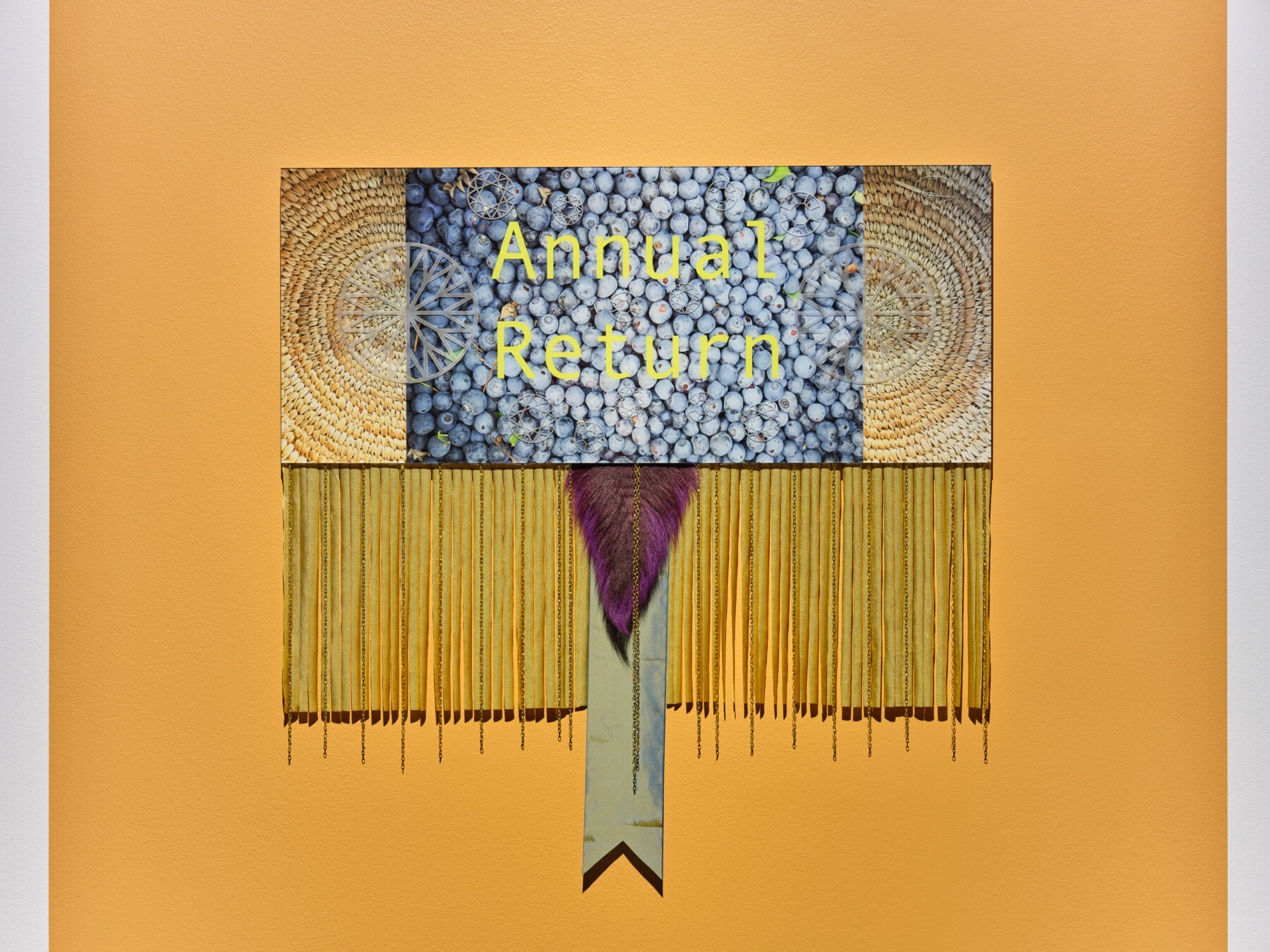
I carry these words into the exhibit and they do not leave me. Catching my eye immediately are Willard’s laser etchings into garnet and corundum sandpaper, the mineral that forms sapphires. Through her choice of materials, Willard subverts the notion of value in a colonial worldview that values an extraction over its living relation. Willard’s Snowbank and Other Investments, a series of inkjet prints mounted on photo paper, similarly plays with the logic of financial investment, this time naming plainly the extractive nature of colonialism in its own terms. Each print features an image of the land or natural element, overlayed with a phrase denoting value within colonial terms – “Annual Return,” “Reserve Fund,” “Domestic Markets” – emphasizing a stark contrast between exploitative reasoning and Indigenous worldviews which value the land as a living relation.
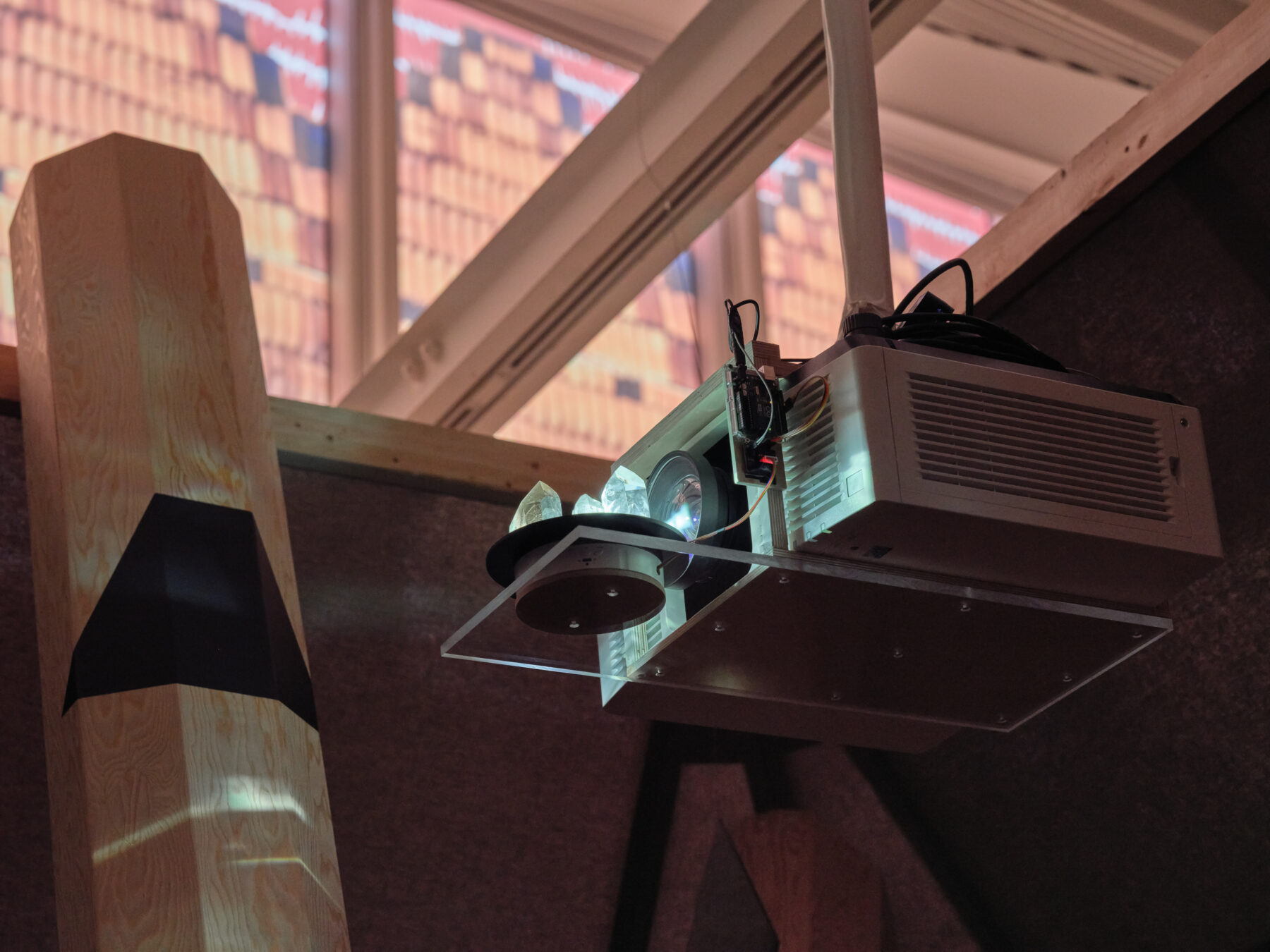
Inside the c7ískten̓, a pithouse structure built within the gallery, Secwépemc people recorded in archival footage move through rotating quartz crystals, further obscured in this unique/new projection. The footage was shot by Harlan I. Smith in 1928, and was created for a settler audience; the exoticising gaze of the film stands in stark contrast to the forced assimilation and displacement that was simultaneously occurring, including through the residential school system. At the time the film was made, Secwépemc life had already been severed from its own reality; the crystals do not corrupt the footage, but rather make its incompleteness visible.
I leave Photolithics carrying something unresolved. The tension between two ways of knowing cannot be rectified in the span of an exhibition, and Willard does not seem to ask this of her audience. Instead, she asks that we stay with the weight of the materials rather than moving quickly towards meaning.
Outside, the mountains sit above the shoreline, neither symbols nor metaphors. They have been witnessing this place longer than any institution, longer than any archive, longer than any photograph. The land does not represent memory; it is memory itself.
- Tania Willard, wall text, Photolithics, The Polygon Gallery, North Vancouver. ↩︎