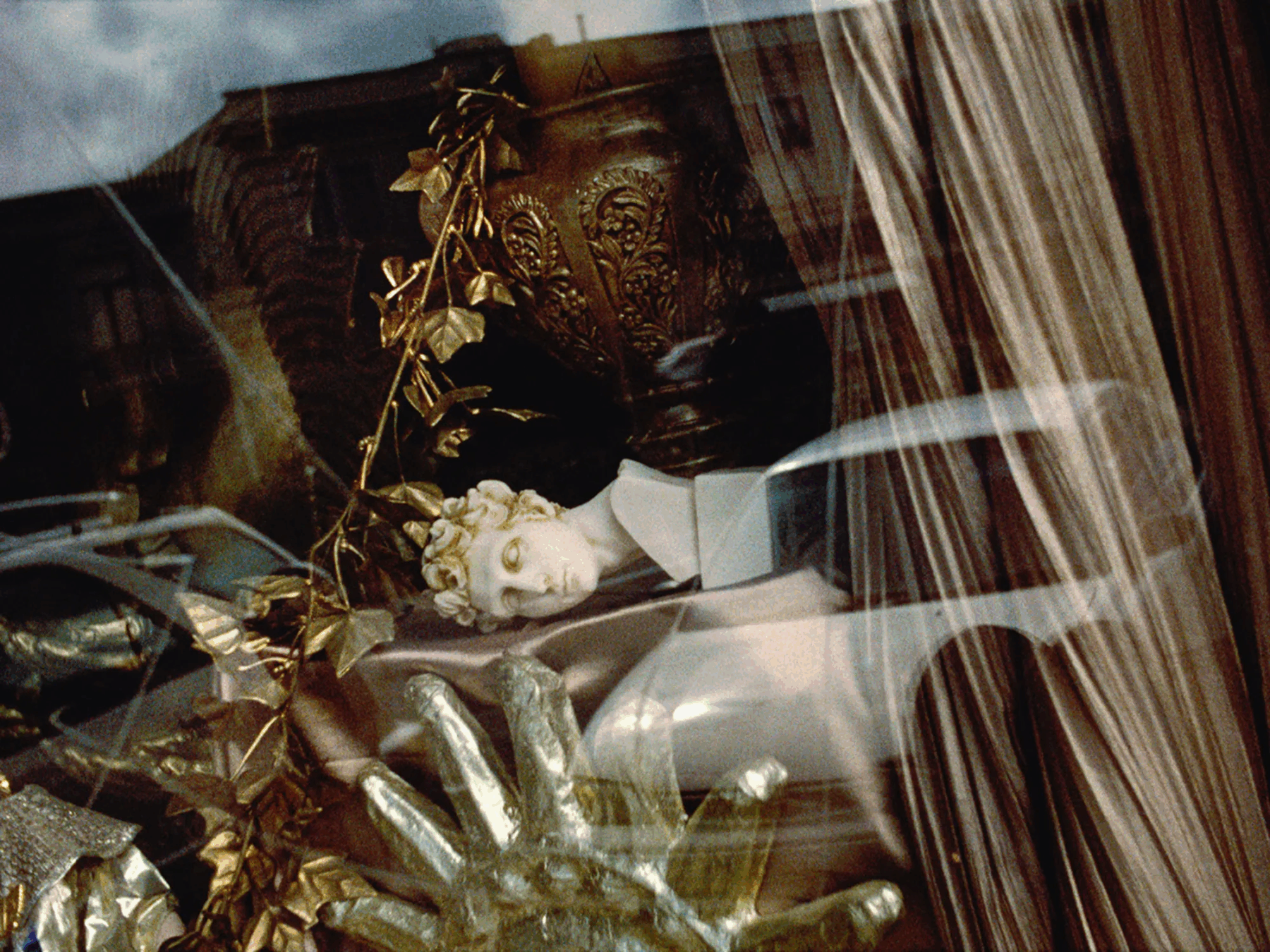
Nathaniel Dorsky, Threnody, 2004, still from a color film in 16 mm, 20 minutes.
During a dream one night, before or after I met a baby
version of myself in Turkey, before or after I sucked on
 a friend’s cock in a park I understood to be “Balkan”

at the top of San Francisco, before or after I debated the category
to which an unremembered food item that tasted like orange
flavored wine on acid more appropriately belonged,

pizza or roll, before or after I found the groins of six
vultures my grandmother had fingered to death,
before or after swimming around

with several slight acquaintances who flopped
on their tummies to play dead if I happened to swim
too close to them, before or after someone said it was seven

or seven was too late, I developed a desire to write
“Dorsky Summer,” presumably after the filmmaker
Nathaniel Dorsky, whose films I spent many hours

watching as part of a retrospective at Anthology
last spring, despite having already done it
a year before. The quality of light—

                 films always have many things going on in any one moment of them

                 —such as the table,
                 —or the pool of rainwater collected on it,
                 —or the way the rain is falling from it,
                 —or the spokes of a parked bike some place behind it,
                 —or the unridden pedal of the bike,
                 —or the imaginary line drawn from the center of the bike and a shadow seen
                 in reverse through the drop of rain on the surface of the previously mentioned
                 table
                 —including light.

                 I’m looking at it all now, pausing on a still from Dorsky’s Variations on YouTube

—was the subject, and underneath the title
“Dappled Boots,” it began “It has come
to my attention,” followed by—

               having spent several weeks now
               searching for what men like Nathaniel Dorsky

               see through the lens as or before they hit
               record, that almost everything
               is dappled by nearly everything else—

               that no matter where one is looking,
               intermittences of light pass
               over and across what’s meant to block them,

               that a leaf wavers constantly, that bark
               is always peeling, that Lindsey Lohan has skin
               that is freckled by the same thing that lights up

               the outside, where a blinding reflection of the sun
               finds its center on the door handle of a Toyota Camry.
               Nothing much dapples in the distance.

              There needs to be some proximity, some sense
              to the operation of one's search for it,
              better seen in a landscape painting than thru a car

             window, compacted in a Hopkins sonnet
             or on a patch of the Hudson. One jumps in before
             doing it and there are always reasons to turn away

—nothing in this one about tables really, or the night
of, though even now I’d be hard pressed to want
anything from the dream, which in short was spent—

              at the surface of a pool of water where legs
              were flung to reach past tummies enough for grandma
              to be fingerrolled or to taste the pizza topping
              that may have been giving Balkan body
              head to the friend with the mouth of the groin
              vulture that was baby me in the park

—it would be a mistake and I made several.
Before, during, and after I watched the films
of Nathaniel Dorsky, I thought they were films

of Jerome Hiler, his partner and that Hiler’s films were
Dorsky’s. Their films are each about twenty-to-twenty-five
minutes long and were screened together in feature

length chunks as part of the same program which I walked into
late several times, and after which I was corrected by my film bro
friends outside Anthology’s Maya Deren theater—

           no the better one is Dorsky,
           no Hiler’s great,
           no he’s the one who shoots whatever’s just there,
           no I couldn’t really get into it, except for the fireworks,
           no, I can’t stay but I want to,
           no but did you see the spokes, incredible,
           yeah, really good,
           no, to understand you really have to see Hours for Jerome, you missed that, well it
           was great,
           and the part with the soap, I kept thinking cum bubbles,
           no you didn’t,
           no I wasn’t.

Dorsky said Maya Deren is the second-best
cinema in the world after his home set up,
which he described as being at the top

of San Francisco, which my non film bro
friend Violet confirmed later with knowing laughter, yea,
Nathaniel would say that, she said, and he’s right,

when he’s not adjusting the screen and the projector
to properly set up the home movies or getting
a little stoned, it is the best place in the world

to watch their films. One time, the two of them sat in front
of me in the theater, another time both sat behind me,
but more often than not, they’d sit on opposite sides

of the cinema, Hiler up front and Dorsky in the way back,
a difference in approach to watching the works
they themselves made which made me think I too was doing it

wrong, maybe even Maya Deren, who was second
best was wrong. Mistakes were the subject of my second
attempt. Which of the two held his camera at the hinge

of a door at the entrance of a diner in the middle of sunny
Sunday afternoon with a precision of focus
that captured absolutely everything there is to see—

          slants of the scaffold
          elbows in cascades
          wheels passing in the reflection and between them
          camera on its side

—Dorsky or Hiler? (It was Dorsky.)
Which of the two really reveled in the smear two
images made in gliding like fruit’s flesh

across one another’s surface, an effect
produced not by the movement of a camera
by a hand but by superimposition,

such that the boundaries between objects
people surface distance sky sea shattered
in ways the mind doesn’t want to let the eye

say they do, drifting in roped circuits like convertibles
on a carnival ride do or pulled in one direction
in order to face one another, then let go? (Hiler did.):

            Hiler versus Dorsky, who wins? They don't
            want to fight but the audience
            needs to prove to themselves
            that they understand

           that the two things they are seeing are
           interacting, the two ways to shoot grass,
           or a set of hands through glass, or to shoot
           the difference between soap and cum bubbles.

           They understand their own films
           in the way that we do, by what one
           another is doing, and by what they are
           not doing. Capturing what “exists,”

          or what you could go to see if you wanted
          to see it versus the lyric modification of the world
          by cinema’s effects plus a movement of eyes
          as they register something very close

          (yellow shroud) versus something very far
         (horizon) as in the opening and closing
         shot of MARGINALIA by Hiler (not Dorsky).
         There are many easy ways to tell

         them apart and there are many ways to love
         the films of either one of them or both even;
         you don't have to choose.
         Should the camera remain still or should

         you be able to trace its movement upward
         or downward or across the placement of another
         element, such as an image? What have you decided?
         You don’t have to. Hiler says that the world changes

         every day, that moments are irrecoverable,
         that any shot is unexpected, and that there is more
         to life than choosing, and he doesn't mind a both/and,
         whereas Dorsky prefers transformative clarity

        produced formally. As in: when is the right time
        to serve a visitor a glass of water? There’s a right time.
        As in: in the case that you find yourself in a vacuum
        of space, that’s fine, crouch down in it and keep still.

Not Hiler. Not Dorsky either.
What I wanted to write I didn't
and what I did write did not align

with the dream, in which what was written was meant
to be for Bianca, who in fact was not in New York for Dorsky
Spring, not sitting beside me with her neck craned in silence.

If anywhere she was in another aisle of dreaming where one knows
what one is looking at, and might be able to describe it accurately
later. I wrote, instead, about apricity

which gives a movie by Nathaniel Dorsky I didn’t see
its name. It began with the line “I'm not going
to the movies today” and continued—

          I won’t see APRICITRY, or PLACE D'OR or CARACOLE (FOR IZCALI) or
          DIALOGUES or INTERVAL or O DEATH, all the shorts by Dorsky and Hiler
          that are compiled as part of the sixth and final program of their retrospective.
          The first movie is about the warmth of the sun in the winter.
          The title means the warmth of the sun in the winter.
          I read that the word has now become obsolete.
          It is a word meant to distinguish the feeling of warmth one feels by the sun from
          the feeling of warmth one feels by air alone.
          The root of the word is Latin, meaning sunny.
          But really it means sunny in isolation.
          Sunny warmth that surprises one as something unbidden in between large swaths
          of coldness.
          It is a window that changes the climate.
          It is the effect of the sun.
          It is the registration of warmth where there’s none.
          It refers to a state, thermal, that changes over time.
          It refers to something that is passing.
          It refers to something that is couched by its opposite in both
         directions (linear).
         I read that the word is too unique to replace in our language because it refers to
         the presence not only of warmth but the light that accompanies that
         warmth.
         It is not a disorientation of two senses, but the confluence of two elements
         affecting two senses at once in a harmonious way.
         The way change is made in the air by the sun via heat.

“Life is full of gaps,” wrote Dorsky in Devotional Cinema,
referring, in summary, to the way films interrupt or open up
our absorption of time to allow for the experience of what is not

in them. He writes about the “no” time that comes after a good one
ends, when those sitting beside us, like in the illuminated room
of dreaming, become temporarily unavailable, or like the center

of what wants to be written, like for Bianca. Regularly unwritten
things appear in dreams without becoming something
to squander, with great delight, lots of time

on regularly. Virginia Woolf wrote a whole
book called Mayview, for example,
which appeared one night, in another.