The Capilano Review is pleased to present Lines into the Air, a year-long series of interdisciplinary writing workshops that take up the communal practice of writing as an urgent means of being and thinking together — across boundaries, fields, and forms.
Highlighting the myriad ways in which writing practices not only exist but flourish outside of disciplinary and institutional bounds, this series brings together facilitators and participants from diverse backgrounds and areas of expertise to reposition creative writing as expansive community inquiry, offering, and exchange.
Each generative, two-session writing workshop will take place either online or in-person across a number of venues located throughout Vancouver’s Lower Mainland. Online workshops will be supported by closed captioning and live ASL interpretation will be available by request for all in-person workshops. Workshops are open to writers of all experience levels. The $45 registration fee includes a one-year complimentary print subscription to The Capilano Review.
Registration is now open for our Fall 2026 workshop season. See below for full workshop and registration details.
Registration Notes:
- Please note that attendance must include both sessions of each two-part workshop — kindly ensure that you are available for both dates before registering to ensure full participation.
- The $45 CAD workshop fee is waived for Indigenous writers — a free ticket option will be available at registration checkout.
- No one will be turned away for lack of funds. A pay-what-you-can option will be available at registration checkout. Any amount can be entered, starting from $0.
Thank you to the BC Arts Council’s Arts Impact grant for its support of this special project.
Lines into the Air: Fall 2026 Workshops
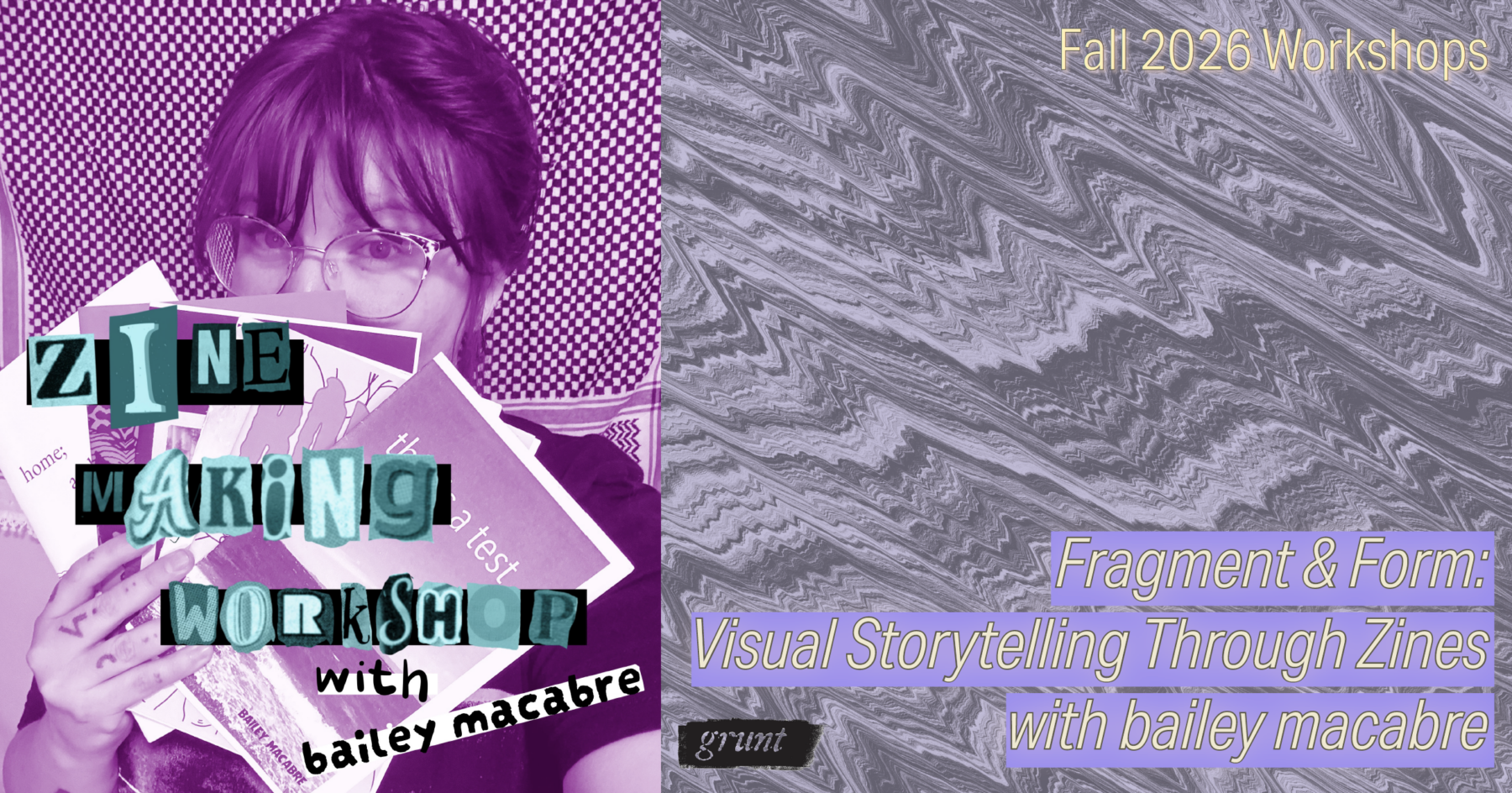
Fragment & Form: Visual Storytelling through Zines
Two workshop options:
Option 1: Saturday, October 24, 1:00pm to 3:30pm
Option 2: Sunday, October 25, 1:00pm to 3:30pm
In-person at grunt gallery (350 E 2nd Ave, Vancouver, BC V5T 4R8)
Registration Fee: $20 / Free for Indigenous participants / PWYC
Please note that registration will close two weeks before each event.
Facilitated by bailey macabre (they/them), a transdisciplinary visual artist, writer, and member of Beardy’s & Okemasis Cree Nation, Fragment & Form: Visual Storytelling through Zines is a soft‑entry zine workshop that celebrates storytelling through fragments. bailey offers a relaxed session where collage, text, and image come together in intuitive, meaningful ways. No experience needed; just curiosity and a willingness to explore. Two workshop sessions are available for this program: please choose one when registering.
About the Facilitator
bailey macabre (they/them) is a queer, disabled, and neurodivergent agender nêhiyaw + Ukrainian born on Snuneymuxw territory, tied to Beardys & Okemasis Cree Nation near Duck Lake, SK. Their interdisciplinary practice is varied and depends greatly on whatever their current hyperfixation is. they are an illustrator, writer, comic artist, textile worker, poet, sculptor, painter, and media artist. Much of their work focuses on themes of queer passion, Indigenous joy, intimacy, Indigenous futurism, and healing. With a penchant for bright colours, Indigenous sovereignty, and deviance in many forms, their work is multifaceted and ever changing. they have illustrated the cover of two of Jen Ferguson’s novels published by HarperCollins, a children’s book published by Medicine Wheel Publishing, and their work has been published by The Walrus, The Capilano Review, The Yellowhead Institute, Augur Magazine, carte blanche, and exhibited at the Nanaimo Art Gallery and The View Gallery (Nanaimo), the Banff Centre (Banff), The Polygon Gallery (North Vancouver), Visions Textile Museum (San Diego), and open space (Victoria).
Accessibility Information
ASL interpretation is available upon request. If you would benefit from ASL interpretation at the workshop, please indicate so in your registration form when prompted.
grunt gallery is accessed from the sidewalk via a 106” long, 64” wide concrete ramp that rises 12”. The slope is 1 : 8.75. There are no rails on the ramp. The front entrance is an outward-swinging double door with a total width of 64”, and with hand and foot height buttons for automated opening. Entry to the Media Lab behind the gallery space is via a 42” wide passage and entry to the neighbouring amenity space is through a manually operated outward swinging double door with a total width of 70”. No stairs, inclines, or elevators are necessary to access the public areas once inside the gallery. grunt gallery has a single gender neutral washroom that is accessed via a 31” wide doorway with an automated swinging door with a door handle that is 40” high. The toilet has a 10” clearance on the left side and a 21” clearance in front, with a support bar on the left side. The sink height is 34”. Please contact grunt via access@grunt.ca with any questions. grunt encourages the use of face masks in our space to help protect immunocompromised staff and guests. Masks and hand sanitizer are available on-site.
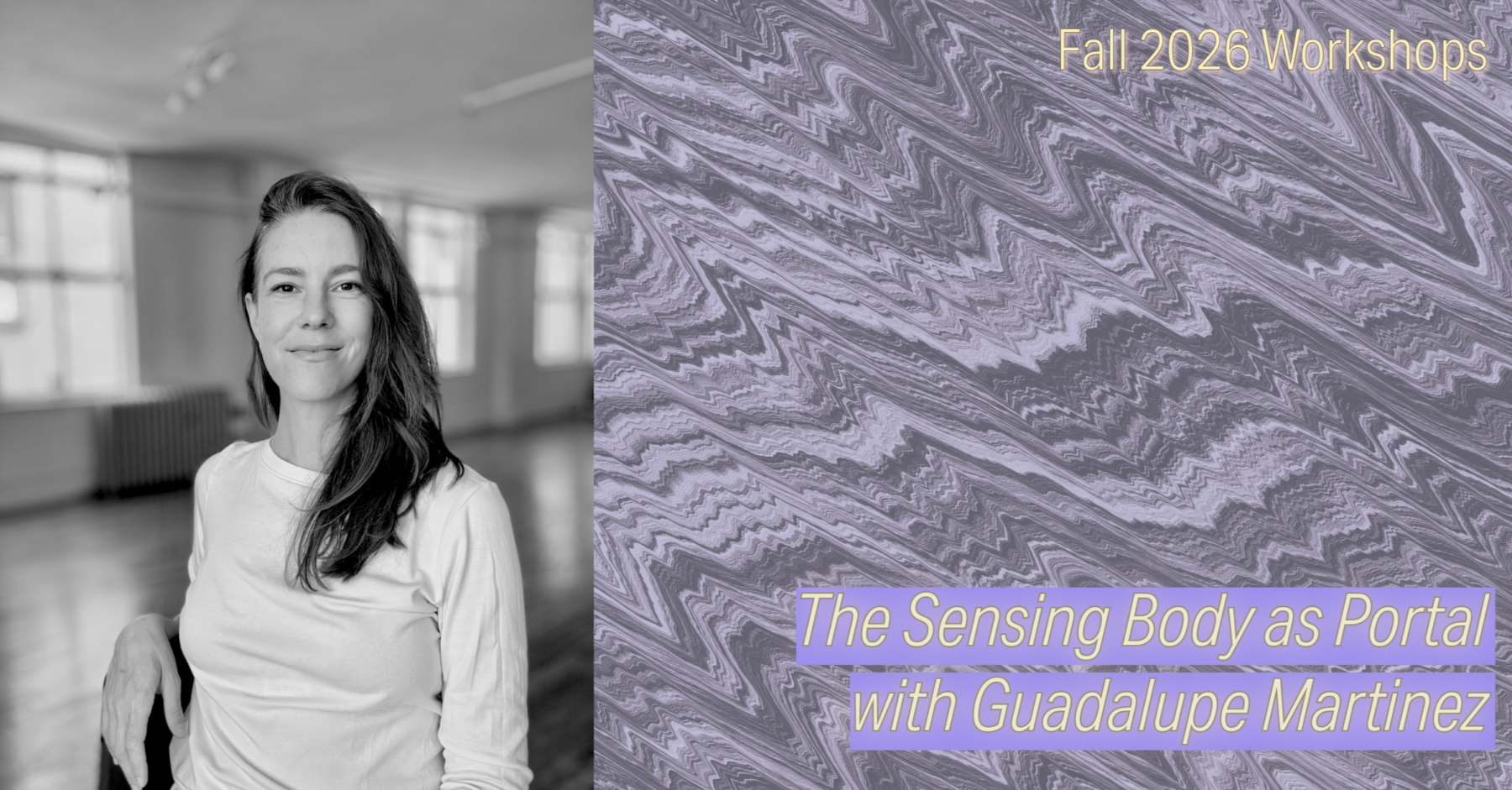
The Sensing Body as Portal, with Guadalupe Martinez
Sunday, November 1 and Sunday, November 8, 2pm to 5pm
In-person at Morrow (Unit 204, 910 Richards Street, Vancouver)
Registration Fee: $45 / Free for Indigenous participants
Register by Sunday, October 18th.
Who are you, beneath the stories you tell? Beneath the gestures you repeat? Are you made of memory? Or the way your body reaches for something it doesn’t yet know? You are movement, you are trace. The one who listens, who forgets. The one who dreams again.
The Sensing Body as Portal is a two-part experiential journey designed for writers, movers, and interdisciplinary creators. Rooted in the frameworks of Sensorial Aesthetics and Active Imagination, this workshop series invites you to step out of linear narrative and enter the imaginal realms of the creative body. Moving through meditative anatomy, somatic exploration, intuitive drawing, and creative writing, we explore the fundamental law of somatic contact: whatever you touch touches you back. Together, we will examine what stories are waiting to be awakened in our inner sensorial and imaginal realms.
About the Facilitator
Guadalupe Martinez (b. Argentina) is a Vancouver-based artist, educator, and facilitator of somatic inquiry and embodied creation. Working across performance art, video installation, depth psychology, and non-dual philosophy, her practice centres on collaborative research-creation to restore intrinsic wisdom and foster collective healing. She is the founder of embodied research-creation group CUERPO Collective Body, the Sensorial Aesthetics Studio, and creator of Expansive Pedagogies, an interdisciplinary framework designed to bridge movement, intimacy, and care within creative research and academic education. Martinez holds a BFA from the National University of Arts in Buenos Aires, Argentina, and an MFA from the University of British Columbia, Vancouver, where she has been a Sessional Lecturer in Performance Art, Actions, and Approaches since 2017. Her work has been shown extensively in Argentina, US, Italy, Mexico, and Canada at the Vancouver Art Gallery, SFU Art Gallery, Or Gallery, Access Gallery, and VIVO Media Arts Centre, among others.
Accessibility Information
ASL interpretation is available upon request. If you would benefit from ASL interpretation at the workshop, please indicate so in your registration form when prompted.
Morrow’s main entrance is located at 910 Richards Street and has one flight of thirteen stairs; elevator access is also available from the back door entrance off the parking lot behind 910 Richards Street, cornering Smithe (it’s a freight elevator, so you may require assistance using it—please let us know in advance and we will assist you). The venue has one wheelchair-accessible washroom and one gender-neutral washroom. Scent-free soap is provided in washrooms and participants are encouraged not to wear scents in the space. Masks can be encouraged and provided on site if needed. Complete information regarding accessibility at Morrow can be found here: https://oddmeridian.ca/policies.html
Lines into the Air: Summer 2026 Workshops
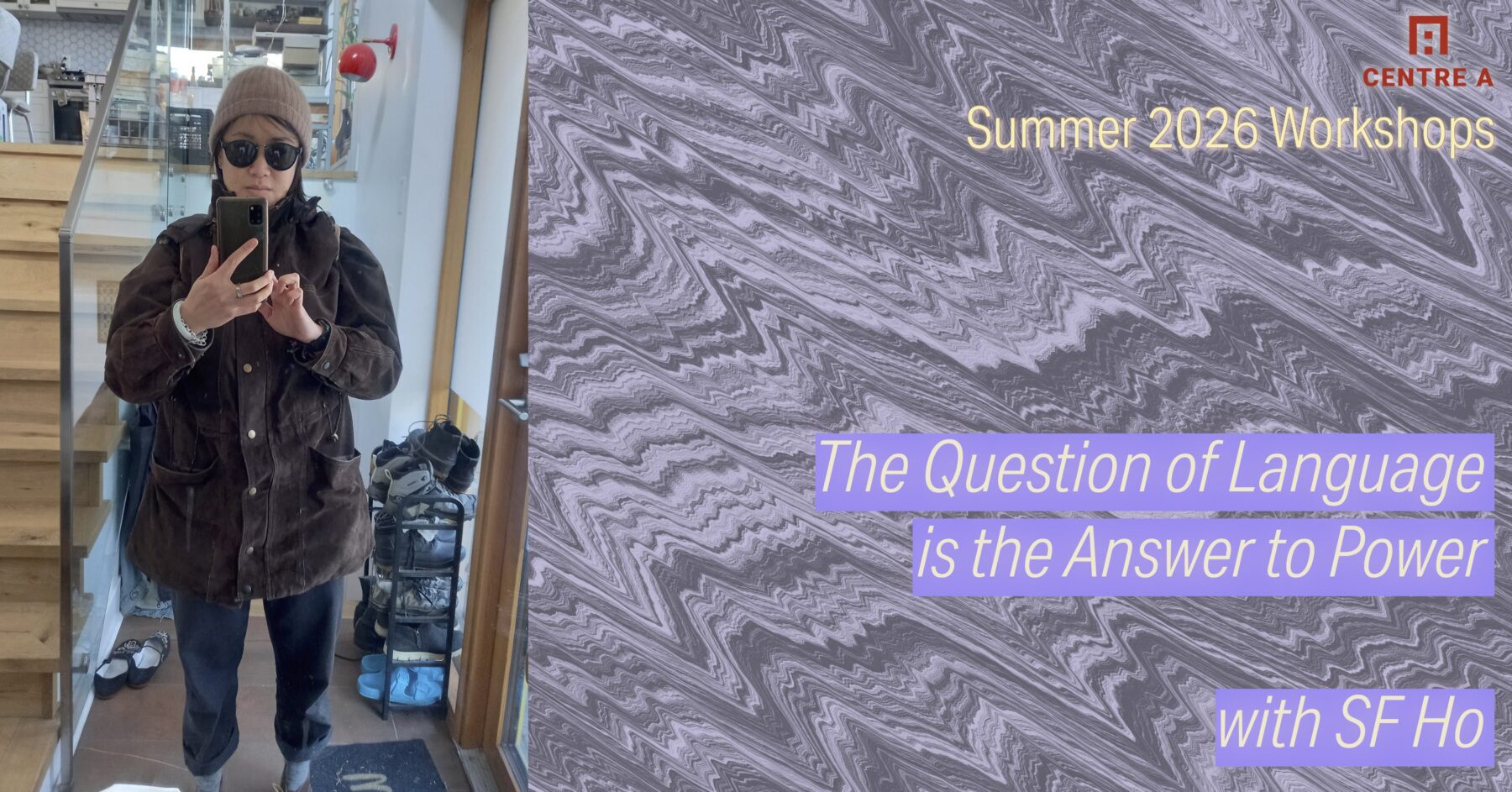
The Question of Language is the Answer to Power, with SF Ho
Saturday, June 13, 2-4pm
Saturday, June 14, 2-4pm
In-person at Centre A (Unit 205, 268 Keefer Street, Vancouver)
Registration Fee: $45 / Free for Indigenous participants
Worlds and experiences are suffused within the formation of language. Conversely, existing socio-political realities are reinforced through the written word. Taking a cue from the title of a poem by M. NourbeSe Philip, this workshop will consider the relationship between environment, society, and the materiality of language. Our concerns include how writing can move beyond strategies of representation and how language may decompose. We will play around with experiential activities and deconstructive techniques. Participants are invited to bring writing and drawing materials, paper or a notebook, and a text that they dislike. Some walking or movement may be involved—please get in touch with contact@thecapilanoreview.com if you have mobility needs.
About the Facilitator
SF Ho is a porous object. They live on the unceded territories of the xwməθkwəy̓ əm, Sḵwx̱wú7mesh, and səl̓ílwətaʔɬ peoples. Operating somewhere between words and whatever words can’t be, their work is informed by feminist methodologies, land-based practices, and grassroots community networks. Ho has presented their art and writing both regionally and internationally. They published a book about love and aliens called George, the Parasite. They’re cultivating a practice of wary sociality, never finishing books, and being sort of boring.
Accessibility Information
ASL interpretation is available upon request. If you would benefit from ASL interpretation at the workshop, please indicate so in your registration form when prompted. Information regarding accessibility at Centre A can be found here: https://thecapilanoreview.com/app/uploads/2026/05/Centre-A-Accessibility-Information.pdf
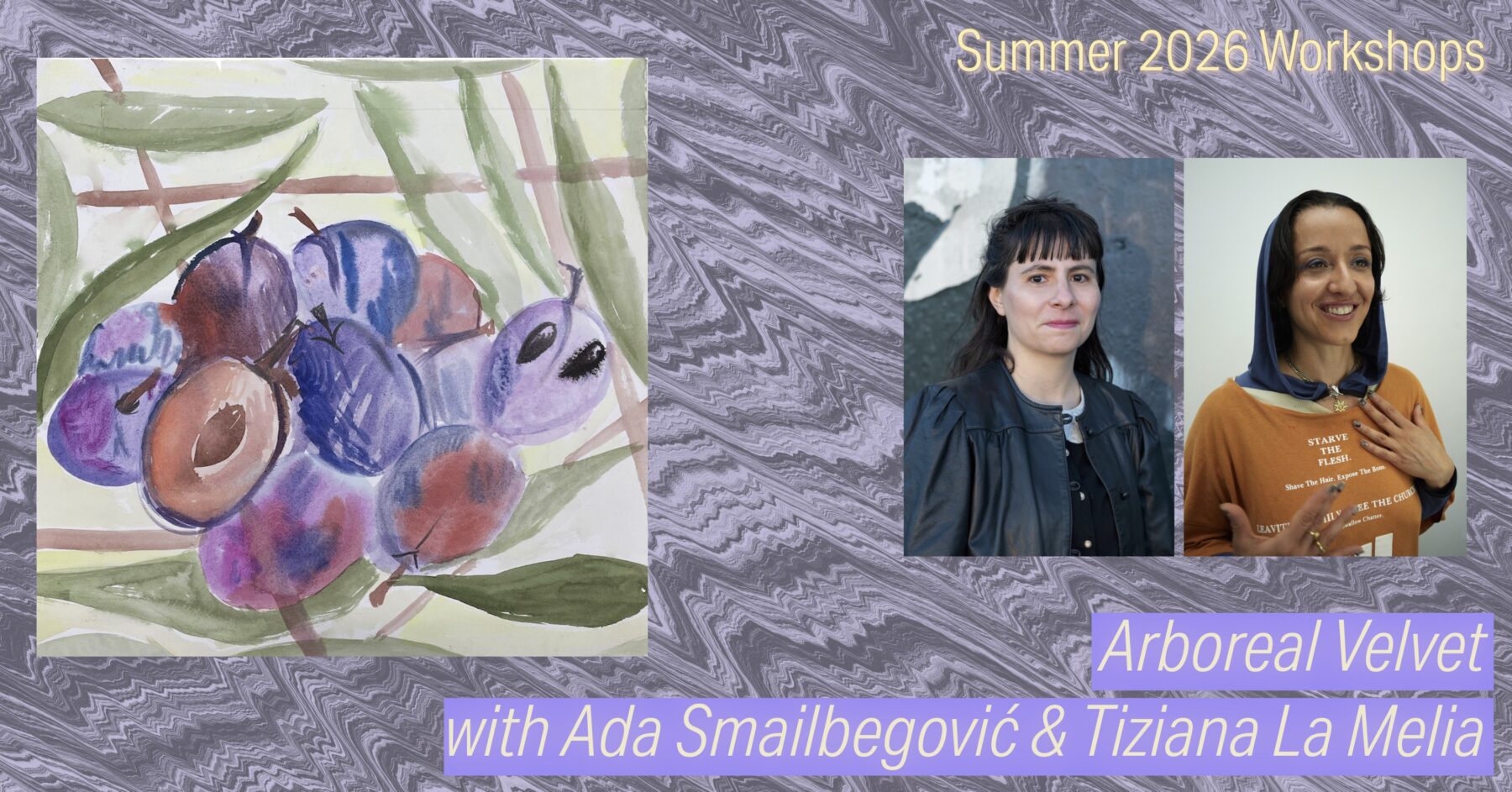
Arboreal Velvet, with Tiziana La Melia and Ada Smailbegović
Saturday, July 25, 1-4pm
Sunday, July 26, 1-4pm
In-person at 221A Project Space (825 Pacific Street, Vancouver)
Registration Fee: $45 / Free for Indigenous participants
The blue of a plum ranges in colour from an indigo to a purple. And even this inconstant primary underlying colour is often smeared with a kind of white dust, an atmospheric haze that indexically links metamorphosis of colour to touch. This substance is known as “bloom,” a fine, powdery film that coats fruits such as grapes and plums giving them a frosty appearance and is in fact the yeast Saccharomyces cerevisiae. To touch the deep arboreal velvet is to mark it, to move the waxy dust around, transferring its white creasing from place to place. In this workshop, we will focus precisely on such material transfers and textures that occur within the interstices of the everyday, as we consider the complexities of creating lifeworlds in the aftermaths of displacement, migration, and war. From this sense of what the theorist Sara Ahmed would call a “migrant orientation,” we will orient ourselves towards the ecological, the botanical, towards the orchard as one of the sites of diasporic time.
About the Facilitators
Tiziana La Melia (b. Palermo) is an artist and author working across many media. In her writing, collaborations, and art practice, she gleans the detritus of the everyday and transmutes it into material textures, and iterative shapes and symbols, which move through layers of diasporic time. Recent publications include I Come From A Long Line of People Who Don’t Use Words (Archive Books, 2022/2025), Glint (Or Gallery, 2025), and Lettuce Lettuce Please Go Bad (Talonbooks, 2024). She has written poems and scripts for and with artists such as Alison Yip, Vanessa Disler, Charlotte Weise, Lotus Kang, Tamara Henderson, Elif Saydam, Nester Krüger, and Sally Späth. Recent solo and two-person exhibitions include Kitten Healer Litter, Galerie Anne Barrault, Paris; Canzone, Unit 17, Vancouver (both 2026); Country Mouse City Mouse Hamster, Or Gallery (2025). Tiziana is based in Vancouver, the unceded territories of the xʷməθkʷəy̓əm (Musqueam), Sḵwx̱wú7mesh (Squamish), and səlilwətaɬ (Tsleil-Waututh) Nations.
Ada Smailbegović was born in Sarajevo and now resides in the emotional triangle between New York, Vancouver and Providence. She studied biology and literature at UBC, completed a PhD in Poetry and Poetics from NYU and is now an Associate Professor of English at Brown University. Her writing explores relations between poetics, ecologies of displacement, nonhuman forms of materiality, histories of description, and the natural sciences. Ada is the author of two books, Poetics of Liveliness: Molecules, Fibers, Tissues, Clouds (Columbia University Press, 2021) and The Cloud Notebook (Litmus, 2023). She is a co-founder of The Organism for Poetic Research.
Accessibility Information
ASL interpretation is available upon request. If you would benefit from ASL interpretation at the workshop, please indicate so in your registration form when prompted. Information regarding accessibility at 221A can be found here: https://221a.ca/about/accessibility/
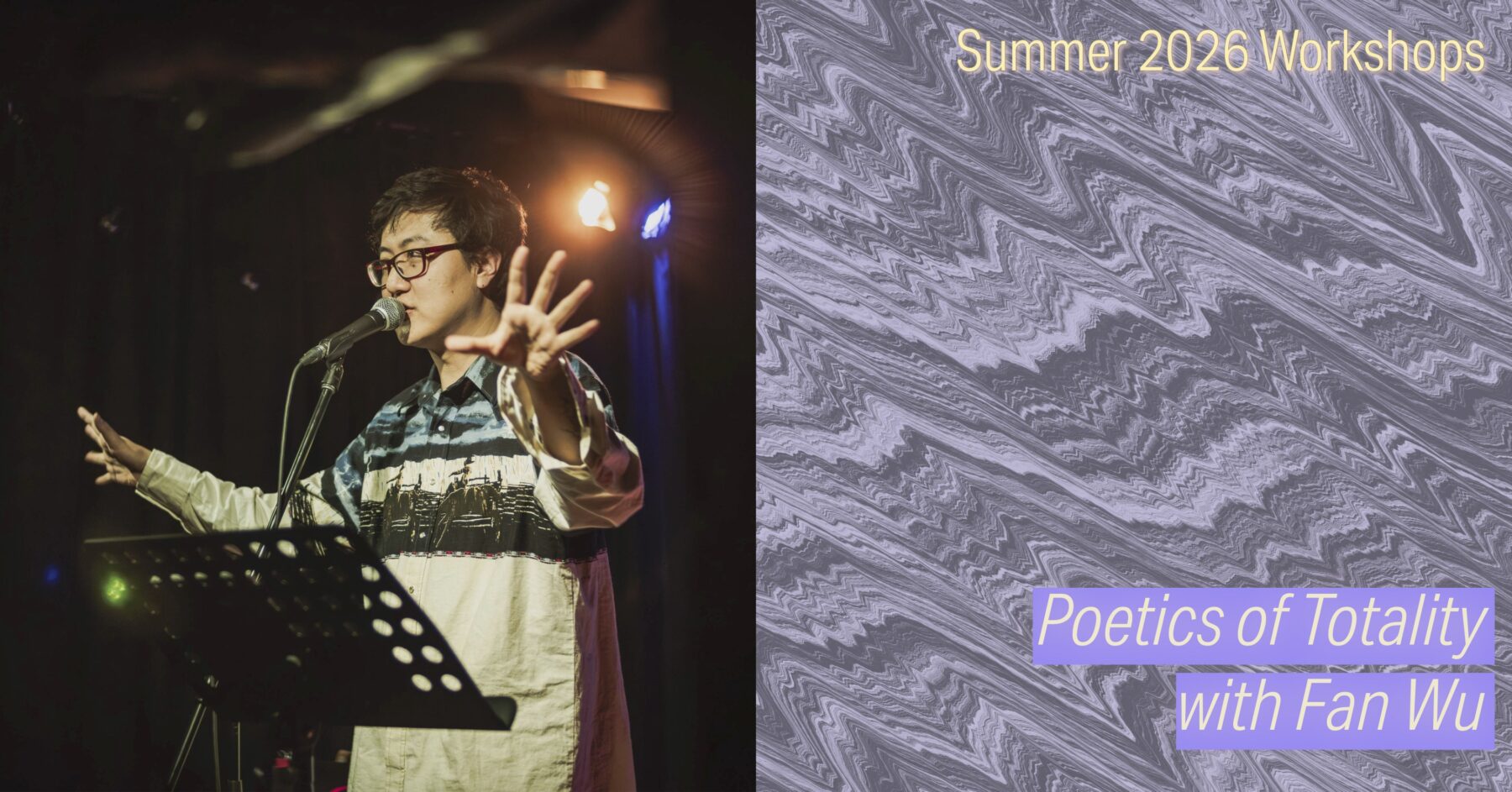
Poetics of Totality, with Fan Wu
Saturday, August 8, 11am-2pm PST (2-5pm EST)
Sunday, August 9, 11am-2pm PST (2-5pm EST)
Online on Zoom
Registration Fee: $45 / Free for Indigenous participants
A poetics of totality excludes nothing from its potential purview; it plays in all of transformation’s crosscurrents; it invites us into a cosmic generosity. In this workshop, we will expand our own writing & reading practices by drawing from the essential interdependence of the world and the ethical-linguistic stance that it entails. We will study with some of my beloved teachers of totality. We will soak in their approaches: the stuplime populist taxonomies of game shows and reality TV; the tele/microscopic metamorphoses of Mei-mei Berssenbrugge and Leslie Scalapino; the Daoist synecdoche of Wang Wei and Du Fu; the deep-seeking queer transgressions of Pierre Guyotat and Robert Glück. Through undisciplined performance art, theatre, and music, we will also reconceive poetry readings in their total context as a social and spatial form. We will be writing & performing separately and collaboratively. Participants may bring a pre-existing project, or start from scratch.
About the Facilitator
Fan Wu writes, performs, and teaches. His current poetics of totality constellates noise music, the Zhuangzi, and participatory aesthetics. His most recent projects include: The Herald at Buddies in Bad Times (as performer), “The Semiotics of Men’s Socks” for Cafe Sprinkle (as writer-performer), and Elixir Frame at Images Festival (as orator & workshop facilitator).
Accessibility Information
This event will be taking place over Zoom. The link will be sent out to participants in advance of the event. Live closed captioning will be available. If you would benefit from live ASL interpretation throughout the workshop, please indicate so when prompted in your registration form.
Lines into the Air: Spring 2026 Workshops
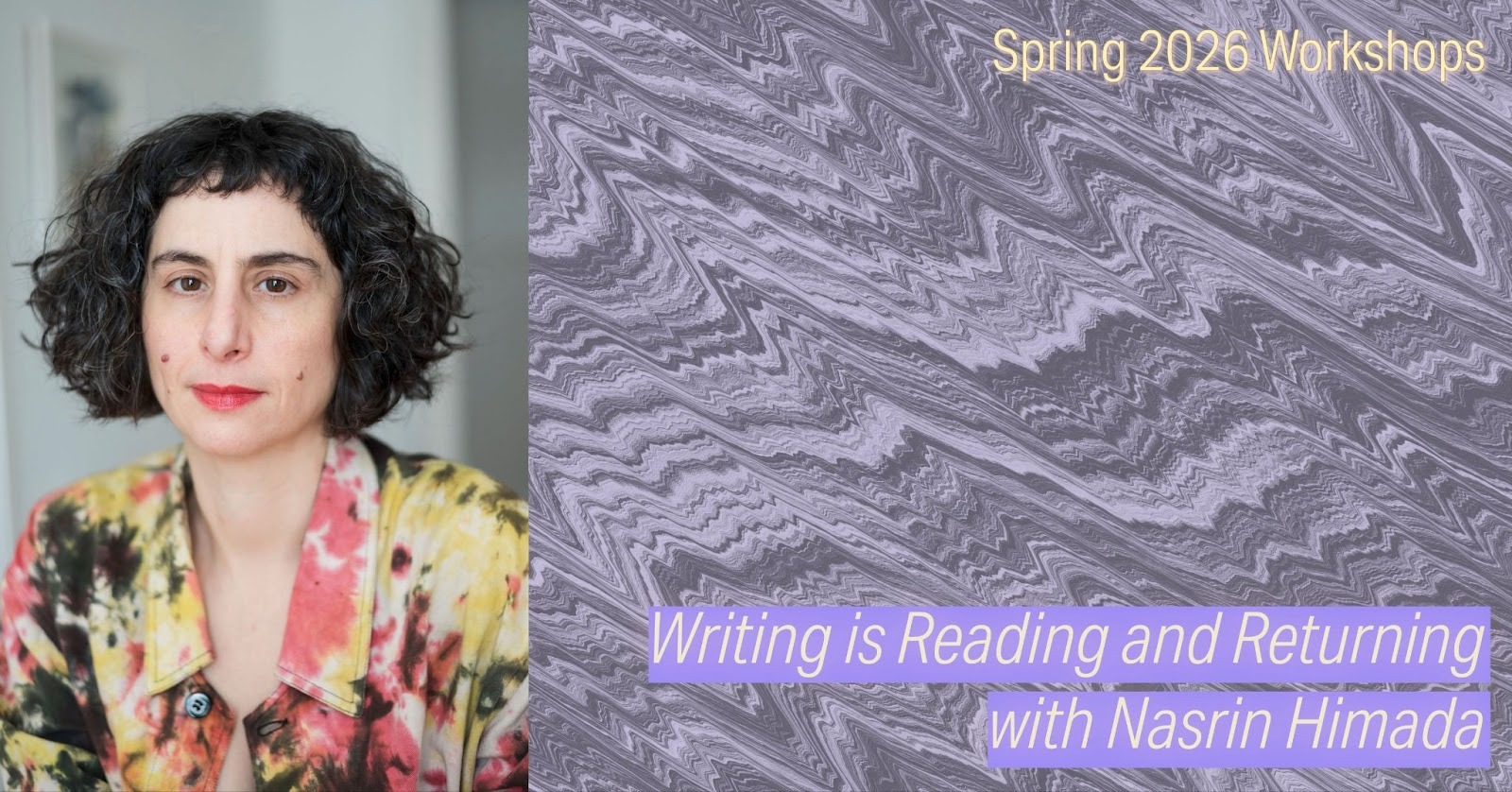
Writing is Reading and Returning, with Nasrin Himada
Saturday, April 18, 11am-2pm PST
Saturday, April 25, 11am-2pm PST
Online (Zoom)
Registration Fee: $45 / Free for Indigenous participants
How do we write through what we love? How do we make space for language to rise to the moment? At the centre of our conversation will be a commitment to not let writing become decorative. We’ll look closely at writers from Gaza who continue to publish and create in the face of ongoing genocide. We’ll ask what it means for us to pay attention, to centre Palestinian voices and their words, and to understand writing as something we owe to life. Participants are invited to bring one piece of writing they have come back to repeatedly: a poem, a piece of prose, a short text that has offered guidance, comfort, or a way through. Together, we’ll read, discuss, and write, exploring how the language we love shapes the language we make. Bring your text, bring your questions, bring your pen.
About the Facilitator
Nasrin Himada is a Palestinian curator and writer. Their practice is heavily influenced by their long-term friendships and by their many ongoing collaborations with artists, filmmakers, and poets. They currently hold the position of Associate Curator at Agnes Etherington Art Centre, Queen’s University.
Accessibility Information
This event will be taking place over Zoom. The link will be sent out to participants in advance of the event. Live closed captioning will be available.
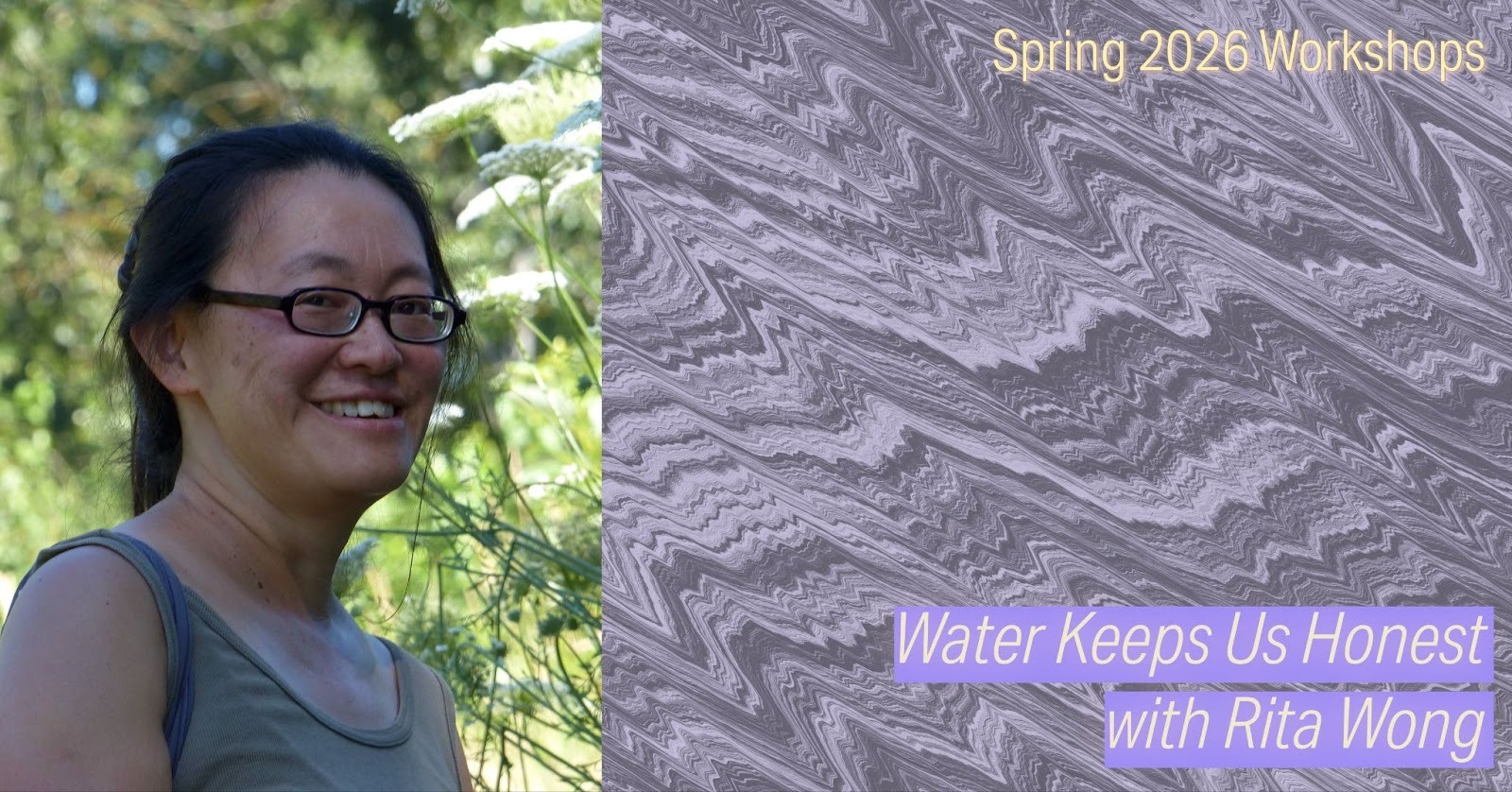
Water Keeps Us Honest, with Rita Wong
Saturday, May 2, 2-4pm PST
Sunday, May 3, 2-4pm PST
In-person at Maplewood Flats (2649 Dollarton Highway, North Vancouver)
Registration Fee: $45 / Free for Indigenous participants
As Lee Maracle wrote, “the water owns itself.” When we focus on respecting the waters enabling our lives, how might we shift our language and our practices? How might we learn from and with the waters flowing through us, or the plants and creatures that water enlivens? Alongside the səlilwətaɬ inlet that is the origin and beloved grandmother of the Tsleil-Waututh people, we will walk together and practice listening to the place that holds us up, stretching towards healthier relationships than colonization allows. We’ll aim to learn from friends like fireweed how to outgrow fascism and stay dedicated to life, in all its vulnerabilities, fierce love, and surprises. Bring a poem to share for these times, a notebook to write in, and a heart open to learn from one another — human and more-than-human companions.
About the Facilitator
Guided by questions of respect for water, collective health, and just relationship, Rita Wong has written several books of poetry attending to the intersections of life, language, and land, and co-edited the anthology Downstream: Reimagining Water with Dorothy Christian. She is dedicated to collective action to address both the climate crisis and systemic inequities through an economy of care and solidarity. Wong has received the Latner Griffin Writers’ Trust Poetry Prize, the Dorothy Livesay Poetry Prize, and the Asian Canadian Writers Workshop Emerging Writer Award. From the Burrard inlet to the Gitxsan lax’yip, we are all endangered by the TMX and PRGT pipelines, which we cannot afford if we want a livable planet.
Accessibility Information
ASL interpretation is available. If you would benefit from ASL interpretation at the workshop, please indicate so in your registration form when prompted.
The venue is located in a spacious room accessible by a paved ramp. There are washrooms on the ground level. Further accessibility details will be added shortly.
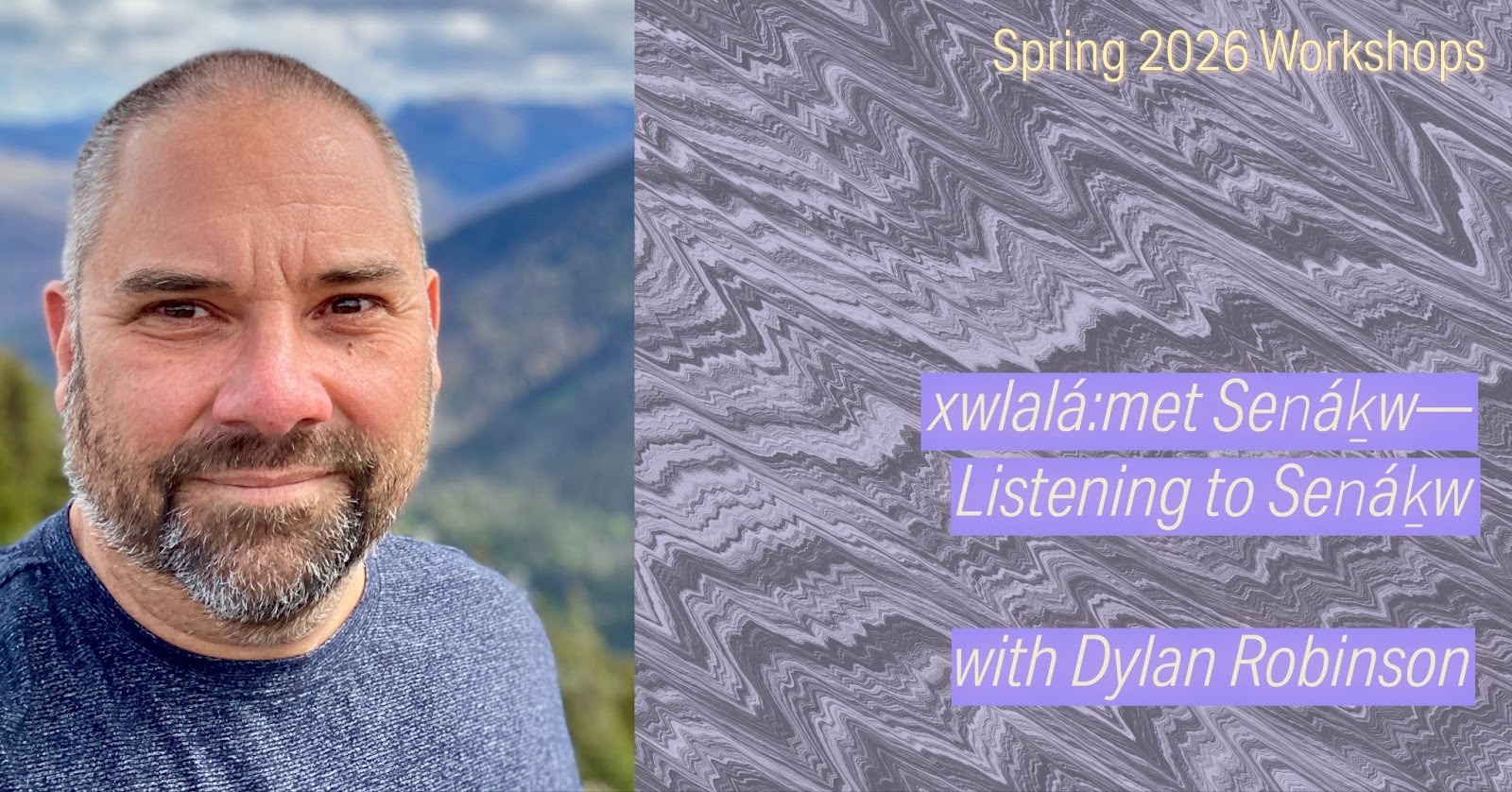
xwlalá:met Sen̓áḵw — Listening to Sen̓áḵw, with Dylan Robinson
Tuesday May 12, 1:30-4pm
Tuesday May 19, 1-3:30pm
In-person at Museum of Vancouver, 1100 Chestnut Street (Sen̓áḵw Village)
Registration Fee: $45 / Free for Indigenous participants
What does it mean to sense our histories to the lands we live with, in the present? This workshop will take place over two sessions at Sen̓áḵw, where we will spend time listening to/with place and connecting that experience through writing to our own histories and positionalities. In response to Lee Maracle’s short story “Goodbye, Snauq,” we will write through a sequence of continuing arrivals, hellos, landings, and visitations, as attempts at naming our relationships to Coast Salish lands.
About the Facilitator
Dylan Robinson is a xwélmexw (Stó:lō / Skwah First Nation member) artist, curator, and professor based at the University of British Columbia. Robinson’s curatorial work includes the international touring exhibition Soundings (2019–2025) co-curated with Candice Hopkins, and his book Hungry Listening (University Minnesota Press, 2020) examines Indigenous and settler colonial practices of listening. His current research focuses on public art’s role in the interpellation of Indigenous and settler subjectivities.
Accessibility Information
ASL interpretation is available. If you would benefit from ASL interpretation at the workshop, please indicate so in your registration form when prompted.
There is a drop-off area in front of the Museum of Vancouver. Curb cuts are located on the right and left sides of the entrance, though there is no curb cut in the middle. There are no stairs leading to the museum entrance, and the door on the right side has automatic door access.
There are five accessible parking spots are available in the EasyPark parking lot. At the front desk, visitors can request accessibility support including a wheelchair and sensory items such as dimming glasses, ear protection, and fidgets.
Washrooms are located on the upper and lower floors and can be reached by elevator; there are no washrooms on the main floor. All the gallery spaces are located on the main floor.
The Local History Room is located on the lower floor and can be accessed by elevator. It is close to multiple washrooms, and the room itself includes a single, all-gender stall. The space also has access to the patio and fresh air.
More accessibility information can be found here: https://museumofvancouver.ca/museum-hours-and-admission