The Capilano Review is pleased to present Lines into the Air, a year-long series of interdisciplinary writing workshops that take up the communal practice of writing as an urgent means of being and thinking together — across boundaries, fields, and forms.
Highlighting the myriad ways in which writing practices not only exist but flourish outside of disciplinary and institutional bounds, this series brings together facilitators and participants from diverse backgrounds and areas of expertise to reposition creative writing as expansive community inquiry, offering, and exchange.
Each generative, two-session writing workshop will take place either online or in-person across a number of venues located throughout Vancouver’s Lower Mainland. Online workshops will be supported by closed captioning and live ASL interpretation will be available by request for all in-person workshops. Workshops are open to writers of all experience levels. The $45 registration fee includes a one-year complimentary print subscription to The Capilano Review.
Registration is now open for our Spring 2026 workshop season. See below for full workshop and registration details.
Registration Notes:
- Please note that attendance must include both sessions of each two-part workshop — kindly ensure that you are available for both dates before registering to ensure full participation.
- The $45 CAD workshop fee is waived for Indigenous writers — a free ticket option will be available at registration checkout.
- No one will be turned away for lack of funds. A pay-what-you-can option will be available at registration checkout. Any amount can be entered, starting from $0.
Thank you to the BC Arts Council’s Arts Impact grant for its support of this special project.
Lines into the Air: Spring 2026 Workshops
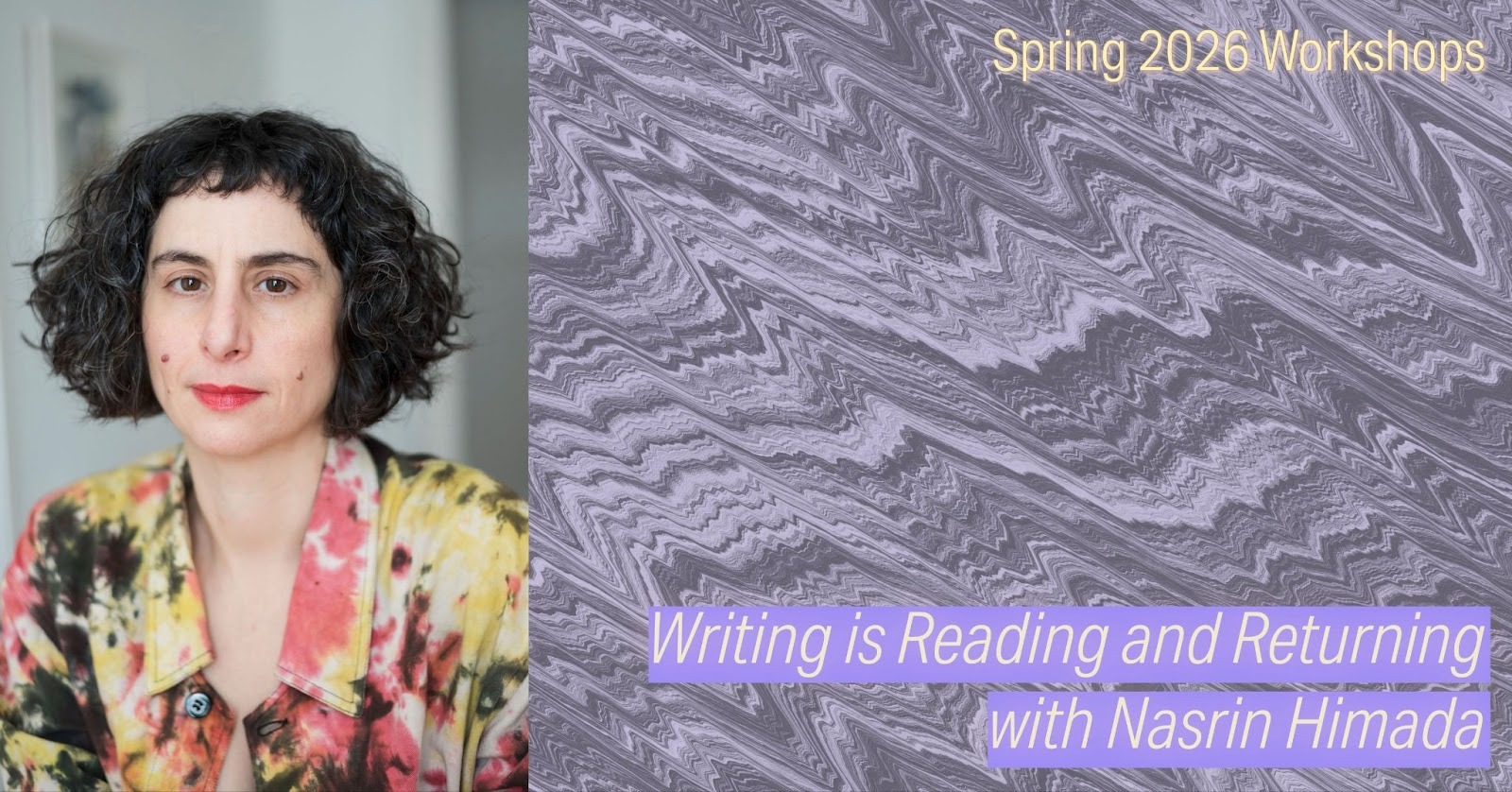
Writing is Reading and Returning, with Nasrin Himada
Saturday, April 18, 11am-2pm PST
Saturday, April 25, 11am-2pm PST
Online (Zoom)
Registration Fee: $45 / Free for Indigenous participants
How do we write through what we love? How do we make space for language to rise to the moment? At the centre of our conversation will be a commitment to not let writing become decorative. We’ll look closely at writers from Gaza who continue to publish and create in the face of ongoing genocide. We’ll ask what it means for us to pay attention, to centre Palestinian voices and their words, and to understand writing as something we owe to life. Participants are invited to bring one piece of writing they have come back to repeatedly: a poem, a piece of prose, a short text that has offered guidance, comfort, or a way through. Together, we’ll read, discuss, and write, exploring how the language we love shapes the language we make. Bring your text, bring your questions, bring your pen.
About the Facilitator
Nasrin Himada is a Palestinian curator and writer. Their practice is heavily influenced by their long-term friendships and by their many ongoing collaborations with artists, filmmakers, and poets. They currently hold the position of Associate Curator at Agnes Etherington Art Centre, Queen’s University.
Accessibility Information
This event will be taking place over Zoom. The link will be sent out to participants in advance of the event. Live closed captioning will be available.
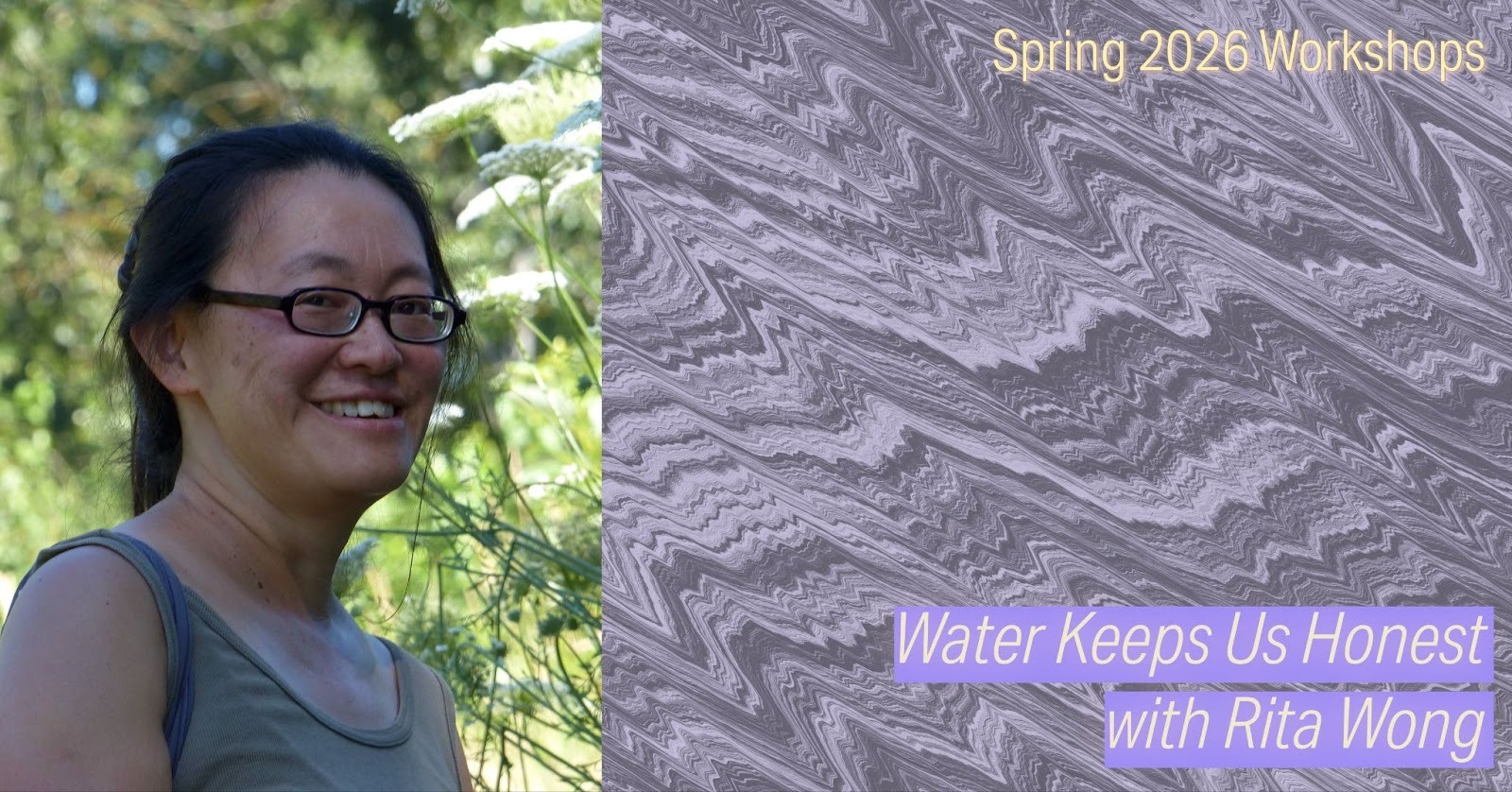
Water Keeps Us Honest, with Rita Wong
Saturday, May 2, 2-4pm PST
Sunday, May 3, 2-4pm PST
In-person at Maplewood Flats (2649 Dollarton Highway, North Vancouver)
Registration Fee: $45 / Free for Indigenous participants
As Lee Maracle wrote, “the water owns itself.” When we focus on respecting the waters enabling our lives, how might we shift our language and our practices? How might we learn from and with the waters flowing through us, or the plants and creatures that water enlivens? Alongside the səlilwətaɬ inlet that is the origin and beloved grandmother of the Tsleil-Waututh people, we will walk together and practice listening to the place that holds us up, stretching towards healthier relationships than colonization allows. We’ll aim to learn from friends like fireweed how to outgrow fascism and stay dedicated to life, in all its vulnerabilities, fierce love, and surprises. Bring a poem to share for these times, a notebook to write in, and a heart open to learn from one another — human and more-than-human companions.
About the Facilitator
Guided by questions of respect for water, collective health, and just relationship, Rita Wong has written several books of poetry attending to the intersections of life, language, and land, and co-edited the anthology Downstream: Reimagining Water with Dorothy Christian. She is dedicated to collective action to address both the climate crisis and systemic inequities through an economy of care and solidarity. Wong has received the Latner Griffin Writers’ Trust Poetry Prize, the Dorothy Livesay Poetry Prize, and the Asian Canadian Writers Workshop Emerging Writer Award. From the Burrard inlet to the Gitxsan lax’yip, we are all endangered by the TMX and PRGT pipelines, which we cannot afford if we want a livable planet.
Accessibility Information
ASL interpretation is available. If you would benefit from ASL interpretation at the workshop, please indicate so in your registration form when prompted.
The venue is located in a spacious room accessible by a paved ramp. There are washrooms on the ground level. Further accessibility details will be added shortly.
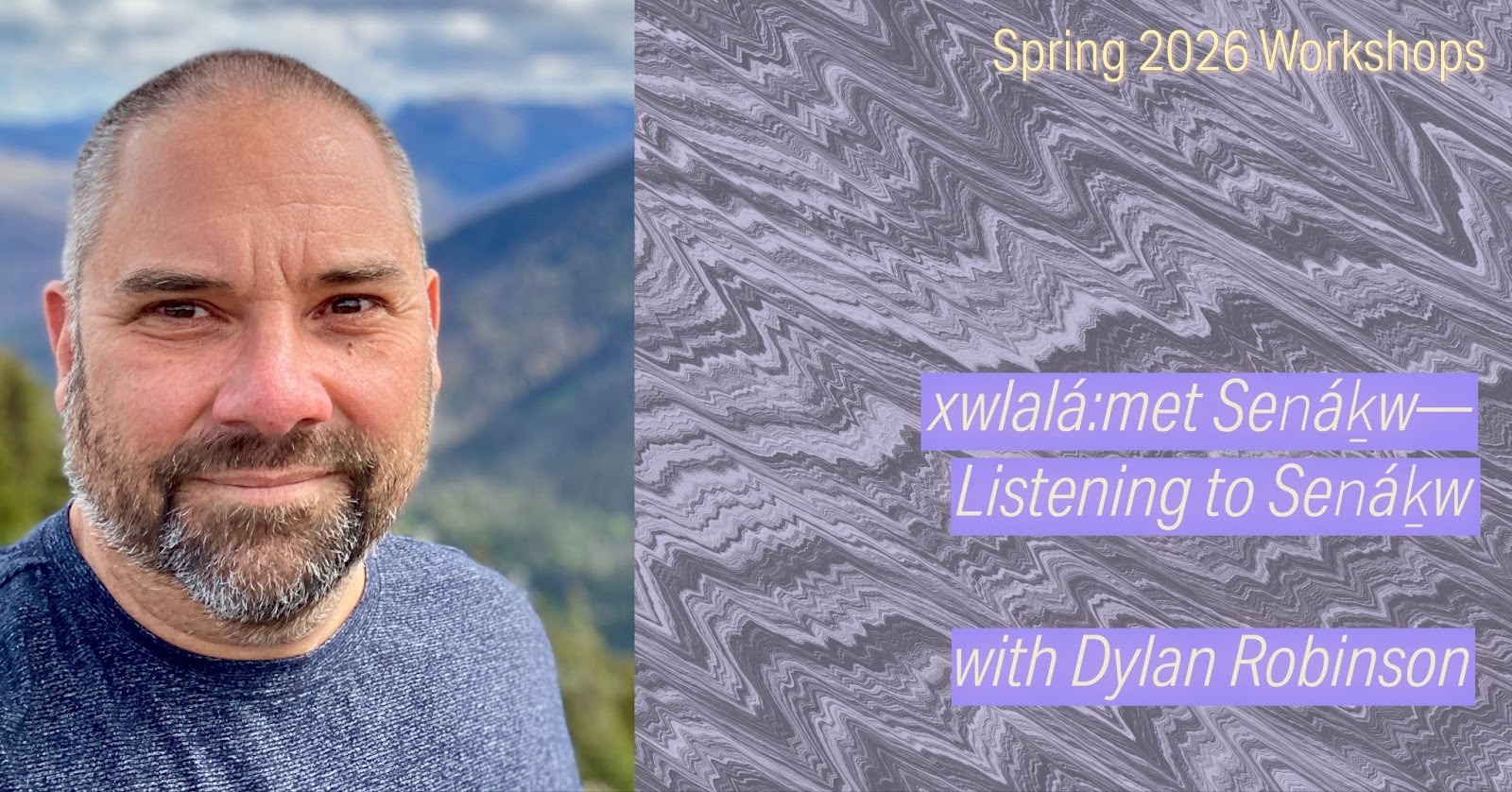
xwlalá:met Sen̓áḵw — Listening to Sen̓áḵw, with Dylan Robinson
Tuesday May 12, 1:30-4pm
Tuesday May 19, 1-3:30pm
In-person at Museum of Vancouver, 1100 Chestnut Street (Sen̓áḵw Village)
Registration Fee: $45 / Free for Indigenous participants
What does it mean to sense our histories to the lands we live with, in the present? This workshop will take place over two sessions at Sen̓áḵw, where we will spend time listening to/with place and connecting that experience through writing to our own histories and positionalities. In response to Lee Maracle’s short story “Goodbye, Snauq,” we will write through a sequence of continuing arrivals, hellos, landings, and visitations, as attempts at naming our relationships to Coast Salish lands.
About the Facilitator
Dylan Robinson is a xwélmexw (Stó:lō / Skwah First Nation member) artist, curator, and professor based at the University of British Columbia. Robinson’s curatorial work includes the international touring exhibition Soundings (2019–2025) co-curated with Candice Hopkins, and his book Hungry Listening (University Minnesota Press, 2020) examines Indigenous and settler colonial practices of listening. His current research focuses on public art’s role in the interpellation of Indigenous and settler subjectivities.
Accessibility Information
ASL interpretation is available. If you would benefit from ASL interpretation at the workshop, please indicate so in your registration form when prompted.
There is a drop-off area in front of the Museum of Vancouver. Curb cuts are located on the right and left sides of the entrance, though there is no curb cut in the middle. There are no stairs leading to the museum entrance, and the door on the right side has automatic door access.
There are five accessible parking spots are available in the EasyPark parking lot. At the front desk, visitors can request accessibility support including a wheelchair and sensory items such as dimming glasses, ear protection, and fidgets.
Washrooms are located on the upper and lower floors and can be reached by elevator; there are no washrooms on the main floor. All the gallery spaces are located on the main floor.
The Local History Room is located on the lower floor and can be accessed by elevator. It is close to multiple washrooms, and the room itself includes a single, all-gender stall. The space also has access to the patio and fresh air.
More accessibility information can be found here: https://museumofvancouver.ca/museum-hours-and-admission