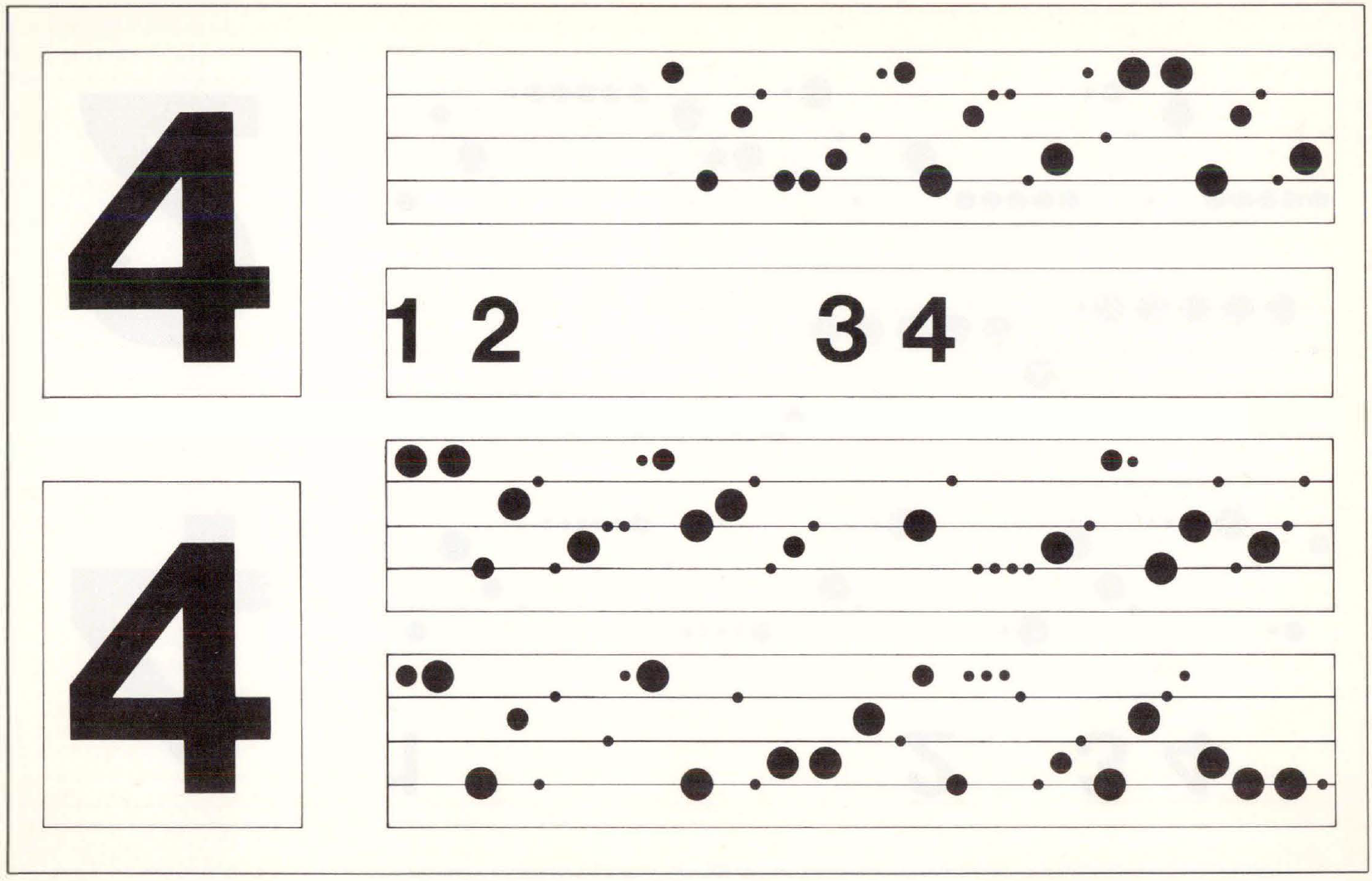
This edition of From the Archives is a double feature. We bring you two collections of work, both focused on fundamental elements of the same ecosystem.
The first collection highlights work that challenges the formal, genric and grammatical status quo. These diverse pieces all seek, in their own way, to destroy and rebuild the vocabulary of their niche, and thus any faith in language as a ‘neutral’ vessel. In “6 Transluçines From the Ajuda Codex by Calgarii Mourii,” Erín Moure combines her translations of several Medieval-age Galician-Portuguese love poems with cut-up fragments of Derrida’s Mal d’archive, sewn onto the translations with thread. This act of collage adds a physical dimension to Moure’s work that is, in turn, flattened into picture; as such, the piece feels inherently transitive, plaited with frayed threads, as it deals in the subjectivity of translation, archive, memory, and love. In “A Sacred Mole, Sacrificed,” Don Druick invites us to parse musical notation with a visual and poetic eye. Taking shape as both art and manual, Druick’s piece involves the audience in the process of creation by pushing the work from one artistic dimension into the next. bpNichol’s sparse, visual poems play with textuality and semiotics in the collection “44 Concrete Poems.” His work is striking in its simple control over the visual, audio, and written implications of language. Nichol’s piece, like Druick and Moure’s, ultimately succeeds in its subversion of common thought about the place, function, and purpose of language.

The second collection features three texts, all analyses of writers by other writers. If the authors of the first collection disrupt conventions of form to create new paths of meaning, the writers of the second are the committed readers that parse the political, practical significance of that disruption and encourage their audiences to participate in it.
The first piece is “Review of Prison Industrial Complex Explodes by Mercedes Eng (Talonbooks, 2017)” by Billy–Ray Belcourt. Belcourt guides the reader through Eng’s radical manipulation of government speech: Eng does not merely comment/depict/portray the cruelty and inhumanity of incarceration, she “operationalizes the language of the state against itself” to demonstrate her point.1 Stephen Collis’ “At War with the U.S. Canada EMPIRE” makes explicit the call to action contained in George Bowering’s At War with the U.S. Collis’ project not only explicates, but expands the significance of the original work: Canada is part of America’s colonizing, genocidal campaigns abroad, today (Palestine) as well as yesterday (Vietnam). Sharon H. Nelson, in “A JUST MEASURE: breath, line, body in the work of bill bissett,” analyzes the political weight of bill bissett’s radical, semiotic poetry, which exposes the structures of oppression lying underneath the conventions of language.
Belcourt, Collis and Nelson each accompany the reader through works that bare and tear apart the boundaries of language in order to reveal what lies below. Mackenzie Ground, in her piece “i await the conversations,” proposes Gregory Younging’s Elements of Indigenous Style: A Guide for Writing by and about Indigenous Peoples as the teacher that will prompt us to grow into a new manner of writing, both gentle and revolutionary. Ground insists “the stories are there and growing” – language just needs to catch up.2
– Millie Beatch and Livia Pica, 2025 Editorial Interns
Erín Moure / 6 Transluçines from the Ajuda Codex by Calgarii Mourii
From Issue 2.46 (Spring 2005)
Don Druick / A Sacred Mole, Sacrificed
From Issue 1.5 (Spring 1974)
bpNichol / 44 Concrete Poems
From Issue 2.4 (Winter 1990)
Billy-Ray Belcourt / Review of Prison Industrial Complex Explodes by Mercedes Eng
From Issue 3.36 (Fall 2018)
“I imagine Eng, book in hand, confronting the police and therefore settlers everywhere with this: “first things first, I’ll eat your brain”
Stephen Collis / At War with the U.S. Canada EMPIRE
From Issue 3.24 (Fall 2014)
“shedding light on the horrible rotten heart, the banal evil of the space from which the bombs come – the space in which the bombs are made.”
Sharon H. Nelson / A JUST MEASURE: breath, line, body in the work of bill bissett
From Issue 2.23 (Fall 1997)
“The attentive reader breathes the poet’s rhythm, breathes with the poet’s lungs.”
Mackenzie Ground / i await the conversations
From Issue 3.36 (Fall 2018)
“Trust. The stories are there and growing. i await the conversations that are taking their first breaths in these pages.”
- Belcourt, Billy-Ray. “Review of Prison Industrial Complex Explodes by Mercedes Eng (Talonbooks 2017).” The Capilano Review 3, no. 36 (2018): 107-108, https://journals.sfu.ca/capreview/index.php/capreview/article/view/3265/3263. ↩︎
- Ground, Mackenzie. “i await the conversations.” Review of Elements of Indigenous Style: A Guide for Writing By and About Indigenous Peoples by Gregory Younging (Brush 2018). The Capilano Review 3, no.36 (2018): 108-109, https://journals.sfu.ca/capreview/index.php/capreview/article/view/3265/3263. ↩︎