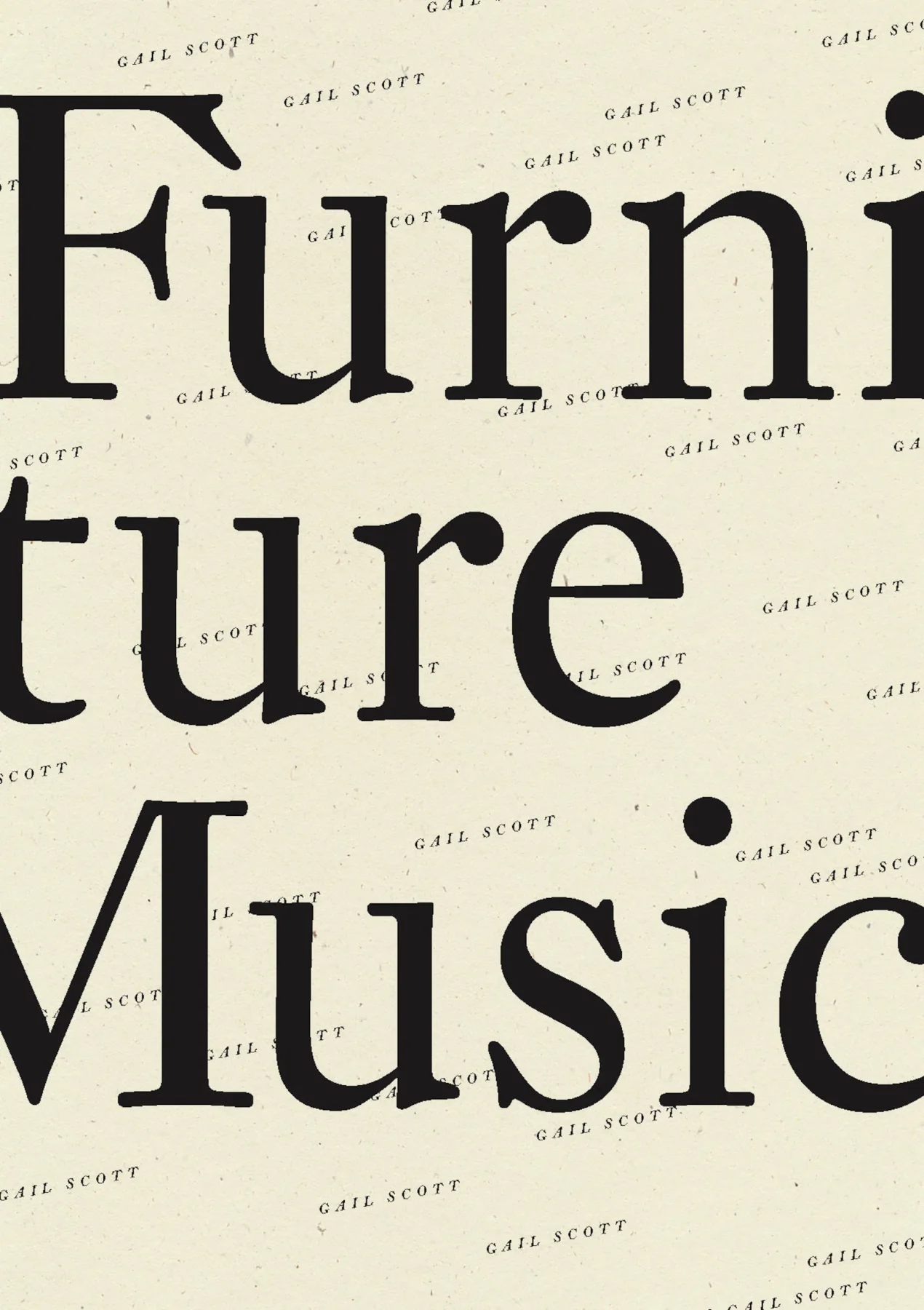
I first met Gail Scott when she attended the inaugural event in my reading series Bellitrist, which I host out of my Brazilian jiu-jitsu gym in downtown Montréal. After stellar readings by Dani Carter, Ashton Diduck, and Clint Burnham, we chatted over a Gatorade about future directions in experimental writing and the overlapping geographies of our everyday lives in Montréal. Shortly thereafter, on the suggestion of Khashayar Mohammadi, I started reading Scott’s Furniture Music (Wave Books, 2023) and was struck by the sprawling and multitudinous network of citations, quotations, and dialogues that cohere in this work—the journalistic, the philosophical, and the intimately conversational. I immediately knew that I wanted to interview Scott for our Dedications issue to sound out the ways that place, community, and writing life are inextricable from one another. While all literature is a product of an author’s social and cultural milieu, Scott’s work more than most thematizes and honours all that constitutes the “surround” of writing.
— Deanna Fong
Deanna Fong
I want to begin with Jacques Derrida’s provocation that “reading and writing are one.”1 Since our conversation is going to be part of the Dedications issue, I wanted to begin by talking about your latest book Furniture Music and the assemblage of people who find their way into the body of that text, as well as into its margins.2 Could we read citation – particularly in the way that it functions in this book – as a form of dedication or signaling to a community who surround the production of the work?
Gail Scott
That was totally the intention. Writing Furniture Music was in part an ode to exchange, written and spoken, in a context of tremendous early Obama effervescence among a group of poets in 2008 Downtown Manhattan. I was there after winning a New York studio residency sponsored by the CALQ [Conseil des arts et des lettres du Québec].
DF
It’s nice to have a place to write from.
GS
Yes. It was a six-month residency, but I was constantly in Manhattan for the next four years. The first Obama term. At the outset I was working on The Obituary, but that quickly morphed into starting work on Furniture Music. I had a mission when I went there. I was hungry intellectually and was looking for a change of scenery. I had been part of the New Narrative movement, which is out of San Francisco, and involved with Belladonna in New York. I knew that there was a kind of curiosity and formal excitement that I wasn’t experiencing quite as much at home anymore, at least in the 2008 milieu in which I was moving. I felt I might find there something like I experienced as a young writer in ’70s and ’80s Québec. It’s so hard to tell people today what a wild, open, “anything goes” time it was. It was even possible to say you were an experimental writer without embarrassment [laughs], or without feeling you had to apologize for what you were doing. To go back even farther, I was a journalist before I began experimenting with prose. I had a very good idea from the get-go of how ideology and language, and media strictures and presumed audience, worked together to create dominant ideas about how things are and how they should be. I understood that I had to find another way to write. Heroine was my first major effort at that. Heroine is a kind of dedication to that effervescent period in Québec. There’s a lot of love in Heroine along with all the contradictions and difficulties of trying to maintain an open marriage in a context where you’re increasingly a single parent and so on.
I felt a pull and desire to be with these New York poets; I knew that I could learn from them about how to change my prose, or how to go on exploring, because at the time the milieu seemed extremely open and curious, and people didn’t seem to be married to fiction, versus nonfiction, versus poetry, versus performance art. It seemed possible just to be some kind of show-off, getting up and doing whatever you felt like. So, I kind of relived what I felt in those early days in Québec in a very different way. With good things and bad things. I thought the political discourse that I experienced in Québec was somewhat more rhetorically worked out, probably because we were feeding on what was happening in France post-May-’68 and all the philosophers we were reading as part of our militant procedural. We read, we discussed, and then we did actions. So, that’s the long answer. [Laughs]
DF
I want to poke at something that you said there, that when you speak of this particular moment in time that Furniture Music frames – 2008 to 2012 – that it seemed to have this sort of enormous possibility for experimentation, openness, and curiosity. But I noticed that you said it in the past tense. Is it a past-tense moment?
GS
I think it’s more that the energy has moved elsewhere. I mean, if you look at St. Mark’s Poetry Project today, it’s really different in terms of who’s reading, who’s running it. When I was there, the milieu was not as diverse as many would’ve liked. This comes up in talking with Renee Gladman and John Keene, among others, in Furniture Music. But at the same time, the fact that Obama was coming to power as the first Black president opened mind-stretching doors. The openness of the milieu, its warmth, curiosity, and generosity of people, too, was really phenomenal. So, yes, it’s a different incarnation. A younger crowd. I think it’s great, the work they’re doing at the Poetry Project. And I would say there is a lot of critical awareness as regards the undertow of neoliberalism which tarnished the latter Obama era. An awareness now essential given the current slide toward fascism. Let’s hope we can check, here and now, as much as possible, the incipient neoliberalism of the Carney moment.
DF
One of the things that I find so impactful about this book is how it’s contained temporally within this boundary of four years, from 2008 to 2012, and geographically by your stay in New York. However, at the same time, some of the themes and political currents that come up in the book seem so present tense. I wanted to pick out one particular one on the opening page: “Had we not seen it all before, money markets falling after rapacious accumulation to ever-insurgent sound of war.”3 It resonates so immediately in the present – heartbreakingly so. So, there’s this funny temporality to the book that’s at once about this return – about recasting all these past moments in the present – but at the same time it’s seeming to speak to the now in a very urgent and arresting way.
GS
I couldn’t agree more – having perhaps learned from how, in the ’70s, les Automatistes québécois, founded in the ’40s, made a spirited comeback thanks to the radicalization of the political context. If there’s one thing about classical narrative – whatever that is, I mean, there’s practically no such thing – it’s that there is an expectation of a movement forward in time toward some sort of closure. And that movement is on a track of deeply embedded influences, political, social, etc. Somebody recently described my work as a playground for language. One of the great things about doing this kind of work is fiddling with the question of how you break narrative when sentencing going from one to the next seems to imply creating some kind of connective tissue. That I, like many, see history as being cyclical, coming around in different ways, fostering my desire to break down narrative. There are many writers of prose over time who to break this movement have written slightly weird, bizarre things using broken and estranging locomotion. Works that are often underappreciated at the time, but which are ironically the kind of prose that often “lasts.” I’m thinking of Robert Walser right now and his non-sequiturs that put the reader in a posture of constant ludic reset.
I have a quote here from the preface that I’d like to read, because I think it goes very well with this idea. In this book, what I start to wish more and more as I go through it is to figure out how to make prose time in the form of a palindrome. This came up after Rachel Levitsky and I went to see Céline and Julie Go Boating. There are two movements through the movie where one girl is pursuing the other, and then there’s a kind of River Styx sequence in the middle where they’re in a boat together and their dead mothers who have been fighting over the same guy go by. Then the movement reverses and the second girl is now pursuing the first. In a way, the narrative form forces a palindrome pattern.
So, here’s the quote, which is very relevant to the book time as palindrome:
The initial 2008 euphoria surrounding Barack Obama. Who in Time’s next pirouette to have been running again. Blown like Klee’s angel into the future. Head bent back against deluge of cumulating hostility . . .4
So that’s the second chunk of Obama’s time.
As if so many. Electoral campaign after electoral campaign. Running toward perpetually promised, unfullable-to-the- point-of-running-backwards . . . HOPE. For we commonly conceive our words as capturing what will have been [in time] . . . yet the future perfect [so hopefully alluded] remains irreducible to this economy. 5
DF
Yes! I underlined that in my copy.
GS
That last bit is right out of Derrida. But l like it in French because the future perfect is called the future anterior ( futur antérieur), literally, in French. The space between the two language connotations fascinates me.
DF
Yes. So, there’s a huge question here when we talk about breaking narrative, especially teleological thrust of the relation between sentences. I wanted to use the event as a way of talking about your book – or at least my path of thinking through the book. So, out in the material world, there are infinite things happening simultaneously – so much so that to us, it’s just a mass of undifferentiated stuff. It’s only when we start to, number one, foreclose some boundaries around what is meaningful, and, number two, start to narrate what the meaning of that foreclosure is to us that anything begins to emerge as significant. That’s the beginning of what we can call an event. We say, “Something has happened.”
GS
Right.
DF
I wanted to suggest that Furniture Music is a book that leans into thinking about how we position ourselves in relation to events, and the very specific voice – or voices – that speak those events into being. Who is it that asserts, “Something has happened”? Sorry, that’s an enormous question.
GS
This question is one that I haven’t articulated to myself in this way – and now you have sent me off to read Alain Badiou. [Both laugh] Nothing ever exists, really, until it’s articulated. The notion of the event seems to be increasingly articulated in the way people form communities and make art. There was a relative single-mindedness to my generation – or at least of my crowd in my generation – which was basically sitting in a smoky room and working very intensely on things and then going out and doing action. We were loyal comrades. Yet, having come to age in ’50s flagship heteronormative families, breaking down personal boundaries wasn’t easy.
I’m not sure, as some think, that the event emerges out of nothing. For me, it emerges out of a collusion of circumstances, out of the indisible or the something unsaid, something not yet articulated. Event requires speech, interlocutors. The fealty to the event is the attempt to articulate what happened or may have happened. But just as Derrida says about the way people think in the future perfect and it doesn’t quite come into being – there’s always something that you can’t quite grasp that you have to reach for.
DF
For sure. But the fact that we can’t articulate it all is what leaves it open to further articulation. This is what we’re talking about when we’re talking about breaking narrative, that there’s always “x” beyond the horizon.
GS
Exactly. I like “x” better than “the void” for that. It leaves space for what we are calling magic here, for want of a better word. The magic of hope. Of desire.
DF
It’s also articulated to this question of who speaks, because I was thinking, “Well, what are the events in this book?” Obama’s election, sure, but then also, “A woman in gray jogging pants walks into the room.” So, the question is: Is it an event if it’s not an event for everybody? What is the threshold for it to become an event? It really depends on the perceiving subject.
GS
I guess that question is, “When does an anecdotal become an event?”
DF
Is falling in love an event, for example?
GS
Oh, yes. The birth of a child. I mean, all kinds of things. I suppose there are singular events and collective events. A great line of poetry, as you said, is, I think, both. Ditto, a beautiful sunset. I don’t think there’s a limit on the notion of event. If I just cross the street, it’s not an event. Unless I get hit by a car. And still, to exist, it has to be put into words. But that takes us to the question of who recounts the event – who speaks when one speaks. This is such an interesting question. It implies an ever-varying amalgam of influences: social, political, economic.
In Furniture Music, that’s one of the reasons I use “Gail” and “you” most of the time instead of “I,” even though it’s a memoir. It was easier for me to make fun of or to interrogate Gail re: her recounting of issues that touched her Black acquaintances so profoundly. At one point in the book, I’m quoting some critique of Obama’s from a white Guardian journalist, and the poet called RG shakes her head and says to me, “Gail, you don’t understand a thing.” [Laughs] Because I was criticizing Obama’s fading social democratic discourse, but in my critique, I was leaving out part of the context, i.e. that of the huge impact his rise to power had for African-American people.
I don’t know how that ties in with the event, but it seems to me that all of us have these things that are unaccountable for us even when we try, and maybe that torques or changes the event – or means that one can never be completely faithful to the event. I expect that’s the case.
DF
This makes me think, too, about the moments in the text where the future-interlocutor Gail – author Gail – reads back into the events in the timeline of the writing. I think these are really important moments of rewriting, reflection, and return – a process of learning via revision. As rob mclennan so nicely pointed out about your book of essays Permanent Revolution, rewriting is part of that process of continuing to shape the narrative as it unfolds in the present and the way that we view the meaning of past events.6 Especially when we think about the subject not as singular, but as an entity who’s unfolding across time and coming back to revisit the purportedly closed sentence of the past. I was wondering if you had any thoughts about the role of rewriting or perhaps the annotation of the past from a present vantage.
GS
Nicely put. I feel like I’m always rewriting my work – even the oldest work that I’ve published. Not that I’m literally sitting down and rewriting it, but the context changes. And you see some things better and other things not so well. You learn more about your own shortcomings and understandings of various positions on the queer-gender spectrum, for instance. There’s always the question of class, which cuts across everything and somehow fails to get integrated into language. That’s crucial. You can’t be an armchair pinko. [Both laugh] You have to be involved in struggles in order to really know what’s going on or to have lived the lives of people who are exploited.
On a personal level, we all come from families where the narrative about what happened is constantly changing or requiring revision in terms of new information, lies discovered. My family is great for that. They’re bottomless. [Both laugh] I could rewrite that story for the rest of my life and be no surer that I was anywhere near accurate. Rewriting is absolutely necessary all the time.
DF
Yes. There’s a real humility to be able to return to those past moments with a willingness to, on the one hand, be generous with yourself, and, on the other, hold yourself accountable for things that you didn’t know that you have since learned. There’s a real vulnerability in that – real humility in that – which I think is at the heart of all good writing, too.
GS
Absolutely. The word humility is underappreciated contemporaneously. At Mar-a-Lago, it’s definitely not a value. [Both laugh]
DF
But sometimes it seems we’re playing the same old tune of having the same debates and the same crises. Like, every line from 1988 can be equally applied to 2025. But I think it’s in that return and that attitude of humility where things start to unfix a little bit.
GS
I guess this takes us back to Derrida’s future perfect, the way it implies both hope and despair, simultaneously.
DF
We did say this was going be a hopeful interview, so there you go. [Laughs]
GS
I think it’s hopeful, first of all, that these questions are being raised right now. I think we’re on the verge of something very . . . I think we’re maybe going to go through hell first, but I go back to the notion that I grew up with, which is, again, of class struggle. We inherited this idea that you had to defeat the dominant class, probably militarily. I think now we’re trying to understand that that needs to be done differently. At the same time, look at what we’re dealing with. How do we cope with the power of corporations and the likes of, say, an Elon Musk?
DF
I think it has something to do with a critical mass accumulating around being able to name something in language. There’s a threshold there. There’s a threshold and then there’s an event. It seems like everything is too small to make an impact until it achieves this critical mass and then all of a sudden: Occupy. Arab Spring. Black Lives Matter. Student sit-ins for Palestine. These things emerge as the result of something overdetermined – we can’t pin them down to a single cause.
GS
No.
DF
So, looping back to this topic of return, the last time we heard your written voice in The Capilano Review was when you were talking with Meredith Quartermain on the occasion of the reissue of Heroine. At the very end of that interview, you talk about Furniture Music, which at that point had not been published yet. That interview happened just before the COVID pandemic hit. So, I was wondering, given our discussion of return and breaking the narrative arc, is there anything in the present that fastens back upon that time in your mind?
GS
Well, in my mind is my writing project, always. I’ve been thinking a lot about how time, when all we had was time, got emptied out during the solitary period of the pandemic. For me, just preceding the pandemic, I had a really bad concussion that took me a year and a half to get over. I experienced the two things similarly as basically having no sense of time and having the mind empty out completely. Which was paradoxical, because at the same time I’ve never felt so free writing anything as I felt writing Permanent Revolution, which came out in 2021. I felt I could say exactly what I wanted because nobody was there to judge. Furniture Music was a completely different story. I was writing about people who were friends I had interacted with.
Right now, I’m writing a book about my neighbourhood, which used to be a neighbourhood of first-generation immigrants. I’ve lived here for forty years in the same apartment. My neighbour when I first moved here was a maid in Westmount, married to a window washer. Now my neighbours include a famous TV actress, a lawyer, and a CEGEP teacher, a substantial shift. That’s within forty years, not that long. It is not the most alluring thing to write about a gentrified street where people have very similar lives in some ways – unless you’re writing a murder mystery – which is tempting, but I haven’t done it so far. [Both laugh] So instead, I’m using figures from Québecois literature, from my old militant life, from history, and I’m inserting them as now-time characters, attempting to make the conglomerate into a Brueghel-like portrait.
So, it’s a countervalent process. Instead of writing about something that for me was incredibly fascinating – a Manhattan poetry context at a particular political conjuncture – I’m taking something that is in the ordinary thrum of everyday life and trying to change it into something else. It’s also a non-narrative piece of work, but I think of it as a novel whose characters rupture the story all the time. [Pause] So that doesn’t answer your question at all.
DF
Great! [Both laugh]
I wanted to ask you, given that Furniture Music is a memoir of sorts, and in this current project that you’re working on you’re fictionalizing, to a certain extent, figures from your life and your past: is there a certain sense of – what’s the word? – I want say “responsibility” but that’s not exactly it. Actually, maybe this is a Dedications question. Maybe I mean fidelity or loyalty to the people represented in your fiction?
GS
In Furniture Music, I mostly relied on the words of poets, the published words of people. Occasionally there was a fairly private conversation or domestic scene. In those cases, I consulted the people involved. Bob Glück has this great way of doing things. He often writes very personal stuff, and then he sends it out to people who appear in the work and says, “Okay, this is what I’ve written. Feel free to change it and I’ll use your changes.” So, it’s a co-authored text, which I think is really smart.
A line that I picked up somewhere going along, which I’ve never totally put aside, is that to write is to betray. To use text/language is to betray because as we’ve been saying, you can never quite grasp the moment because there’s always something that escapes. Ditto for those who may show up in your work. In fact, I think the mystery around the edges, the ungraspable, is what makes it interesting.
When I was a young writer, I didn’t think about trying to achieve fealty of representation. I just did what I wanted to do. I know some people got troubled by that, and retrospectively I felt bad. And yet I had to do it, otherwise the story would’ve been something altogether different if I had suppressed the emotions I was experiencing and worried about exactness. I think I was forgiven eventually. But I think you must write, but then you have to think about it.
DF
I think if we are writing from a place of love because we love our community, we care about our community, then that’s the compass. Of course, we all fuck up sometimes, but like you said, we’re often forgiven if we are coming from a place of love.
GS
But then there’s a question of what our community is. We can’t honestly claim to love all communities, you know? So where do you draw the line around that community? I’m not sure.
DF
Well, that was my last question for you, I guess: if we’re speaking of dedication as being dedicated to both a practice – writing – and also to a community that one cares about, what delineates that community for you?
GS
I don’t think that I’ve ever actually managed to have an endurable community in the smaller sense of the word. I’ve allowed myself to keep moving topographically. Broadly speaking, feminism cut across by class and queer issues lends a notion of community. Yes, I love you all, but . . . [Both laugh]
I believe this tendency begins in childhood. And I’ve seen it in the work of Camille Roy, for example. A Chicago-born San Franciscan who spent part of her childhood in various Muslim countries. The first eight years of my life, I was an Air Force brat. We moved all the time, so I never learned how to make enduring connections in my formative years. Then we moved to this small town that was half French and half English, right on the Ontario- Québec border. The kids in my immediate purview were French, so I played with the French kids, but that meant that I wasn’t really part of what should have been my community, which was the Anglo community.
For a long time, I was an Anglophone writer in a Montréal Francophone milieu. One of the reasons that I found to go to New York was that I wasn’t getting read much in English. My work is not easy to read, and people weren’t able or willing to read it in English seriously enough to get it. I never got the public response that I might have gotten had I been living and writing in English somewhere else. But both the New Narrative people and the people in New York were able to engage in certain discursive inclinations embedded in a somewhat mutual grammar. I knew that I would have readers there.
If my relation to notions of community has been somewhat peripatetic, I’m home again and it feels great. I’m meeting lots of people these days who are part of the local milieu who have no problem with this language barrier that seemed such a problem when I was young. I’m also feeling very alienated to a lot of the political culture south of the border. So, I feel like my community will be very local for the rest of my life. I feel like I know all these fabulous individuals here, but they’re all in different spots and in different places in their lives, from millennial friends to people who are older – which is really getting on – and I just have this great desire for everybody to meet and get together and have a mammoth party.
DF
Let’s do it. Now that would be an event.
- Jacques Derrida, “Plato’s Pharmacy,” Dissemination (London: The Athalone Press, 1981), 63.
↩︎ - Gail Scott, Furniture Music (Seattle: Wave Books, 2023). ↩︎
- Gail Scott, Furniture Music, 3.
↩︎ - Ibid, 5
↩︎ - Ibid, original emphasis.
↩︎ - rob mclennan, “On Gail Scott’s Permanent Revolution: Essays,” The Capilano Review, https:// thecapilanoreview.com/on-gail-scotts- permanent-revolution-essays-with-a-foreword- by-zoe-whittall-and-afterword-by-margaret- christakos/. ↩︎